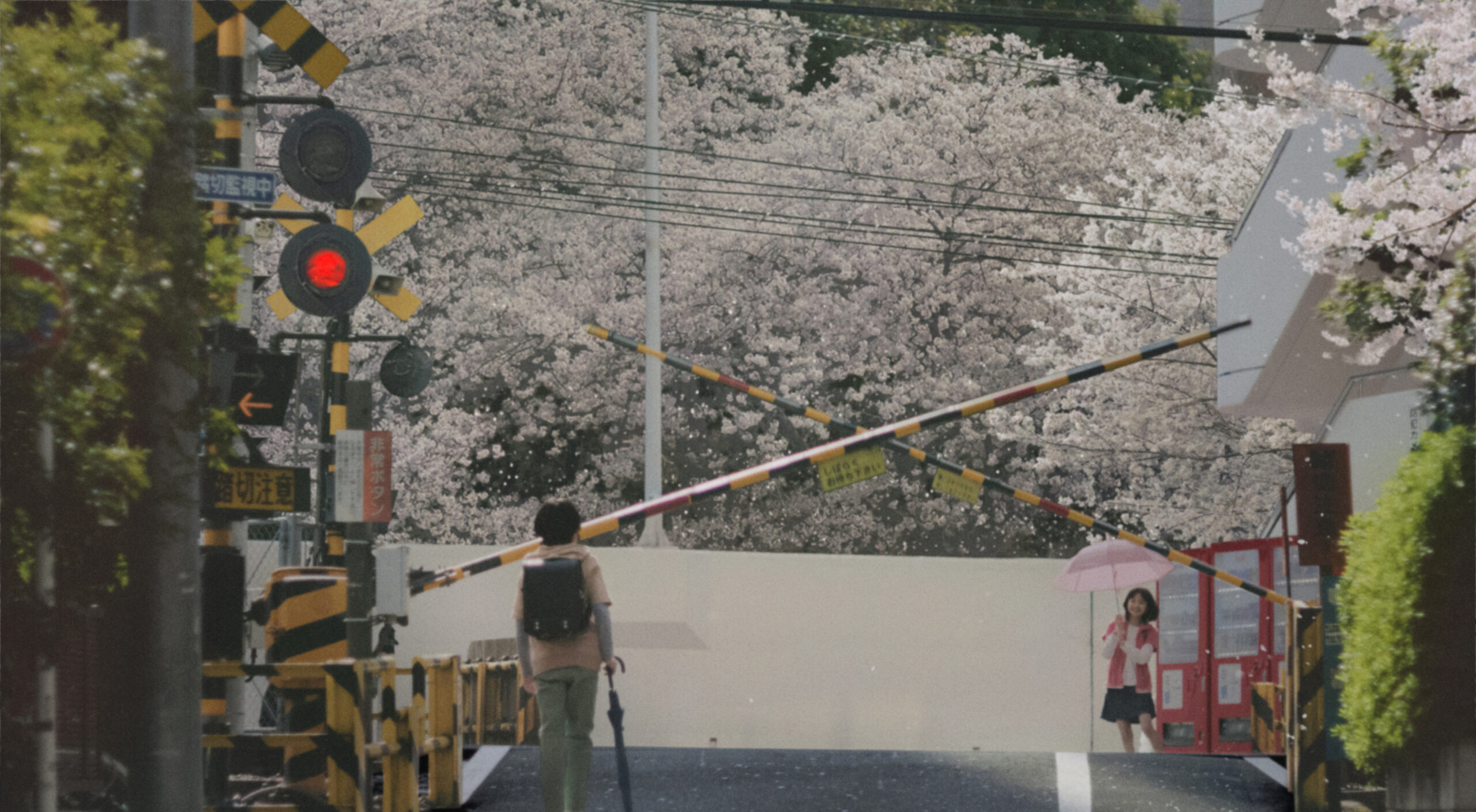
©2025 "5 Centimeters per Second" Film Partners
MOVIE REVIEW
5 Centimeters per Second (2025)
I cannot imagine any hardcore Makoto Shinkai disciple not combusting into violent, hyper-ventilating rage the moment J. J. Abrams announced a Hollywood live-action remake of “Your Name.” For the otaku ecosystem, it was an existential threat: the impending, inevitable Americanization of a grailed masterpiece whose very DNA is bound to Japanese cultural specificities. Though nothing has materialized in the ensuing nine years since that threat was issued — offering the collective relief of a stayed execution — the post-traumatic stress of the mere proposal still lingers like radiation.
It was with this exact protective crouch that I approached Yoshiyuki Okuyama’s “5 Centimeters per Second,” a live-action reimagining of Mr. Shinkai’s seminal 2007 eponymous anime. For years, the original had eluded me in a theater. I missed a rare screening at Toronto’s Carlton Cinema amid the frantic, transactional haze of TIFF, where I was a freelancer on a mission, unable to justify sparing even an hour for personal edification. Ultimately, my introduction to Mr. Okuyama’s vision occurred under conditions that would make any cinephile weep: on an 8-hour flight to this year’s Venice Film Festival, squinting at an in-flight entertainment screen barely larger than an iPhone, bolted to the economy seat in front of me. Yet, despite the spatial indignity, the film’s melancholic gravity pulled me clean through the glass.
The film opens as Takaki (Hokuto Matsumura) wanders through a maze-like exhibition that we later discover is nested inside a planetarium — an apt metaphor for a man obsessed with distant, unreachable celestial bodies. By day, he is a Tokyo computer programmer, wrapped in the classic tech-worker armor of perpetual withdrawal. He doesn’t just navigate the world; he actively shuts it out. This icy demeanor naturally captures the eye of his colleague Risa (Mai Kiryû) whose subsequent romantic entreaties are met with a masterclass in emotional stonewalling.
As the narrative folds backward into memory, we learn that this is not his first time breaking a heart; it is simply his default setting. In elementary school, a young Takaki (Haruto Ueda) and Akari (Noa Shiroyama) become fast friends, bonded by the specific, rootless loneliness peculiar to children of migratory corporate families. Their tightknit alliance is cursed from the jump: Akari’s family relocates to Tochigi in due time, and by middle school, Takaki is destined for the remote island of Tanegashima. A final, desperate attempt to meet at an isolated train station in Iwafune is nearly scuppered by an unyielding snowstorm. In high school, Takaki (now played by Yuzu Aoki) freezes out the warm, surf-side overtures of a classmate, Kanae (Nana Mori).
To appreciate what Mr. Okuyama has achieved here, one must understand the structural mathematics of the adaptation. Mr. Shinkai’s original anime ran a spare, episodic 63 minutes. Even when factoring in Mr. Shinkai’s own light novels and the subsequent manga expansions, stretching this fragile, atmospheric tone-poem into a 123-minute feature is a precarious leap. Yet Mr. Okuyama, working from a deeply intelligent screenplay by Ayako Suzuki, avoids the trap of narrative bloat. Instead of adding filler, they expand the story inward, transforming Mr. Shinkai’s gossamer-thin anime archetypes into characters with real, heavy psychological friction.
The film’s very existence is sure to alienate many purists. Mr. Shinkai’s signature hyper-saturated skies and photorealistic light-streaks are the foundation of his mythos — the very things that earned him the double-edged crown of Hayao Miyazaki’s heir apparent. But Mr. Okuyama wisely refuses to build a digital cover-version of that aesthetic. Instead, he grounds the film in a tactile, melancholic realism that trades anime grandiosity for the lush, sun-drenched nostalgia of ’90s J-Cinema. The visual language shifts from Mr. Shinkai’s cosmic maximalism to something deeply reminiscent of Shunji Iwai’s “When I Close My Eyes” — all soft focuses, architectural isolation, and the quiet ache of spaces left empty.
Where the remake truly stakes its claim, however, is in its willingness to fix the original text’s emotional myopia. By fleshing out the collateral damage of Takaki’s obsession — giving real interiority and weight to the women he leaves in his wake — the film becomes less about a romanticized tragedy and more about the toxic rot of nostalgia. The revised ending improves significantly on Mr. Shinkai’s original punctuation, trading fleeting, melodramatic missed connection for a far more devastating and mature realization about what it means to actually move on. It deeply satisfies this particular skeptic, even if it leaves me more eager than ever to finally chase down the original on a screen larger than a postcard.
Comments