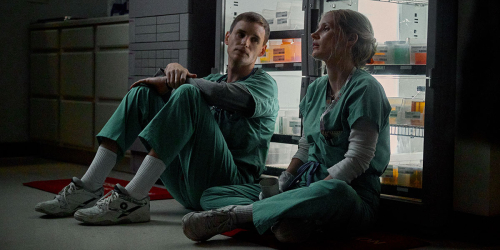
Courtesy of TIFF
MOVIE REVIEW
The Good Nurse (2022)
The main topic of “The Good Nurse,” which had its world premiere at the Toronto International Film Festival, is healthcare under capitalism, while its subtext is the power of kindness. It’s important to make that explicit since there’s a worrying recent trend for audiences to interpret “based on a true story” to mean that what is shown on screen is exactly as things happened in real life. There is no longer tolerance for changes to serve a cinematic purpose (such as the third child in “The Diving Bell and the Butterfly”) or in order to simplify complicated plots (such as when multiple characters are combined into one in almost any film). Netflix has pushed this “based on a true story” to new limits, by having the subject of the brand-new “A Friend of the Family” appear at the start to assure us it exists with her blessing. There is some argument for this – if someone made a movie about my life while I was still alive to see it, you had better believe I’d expect all my irritating opinions to be respected by the filmmakers. But there is also a strong case for a better understanding about the blurred lines inherent in any retelling – life is messy and complicated, and sometimes sanding the edges makes for a better story. On a less philosophical level, a better understanding of how fiction handles the truth would also cut down on spoilers, and more easily enable us to examine a piece of art on its own terms. Nothing is ever only about itself; there’s always subtext. “The Good Nurse” is also a Netflix film, and also based on a true story, but writer Krysty Wilson-Cairns (a Brit, ie someone from a nation with socialized healthcare) and director Tobias Lindholm (a Dane, also from a nation with socialized healthcare) are uninterested in sensationalizing suffering. For once we have a movie which minimizes its depiction of pain.