Magnet Releasing
MOVIE REVIEW
Mandibles (2021)
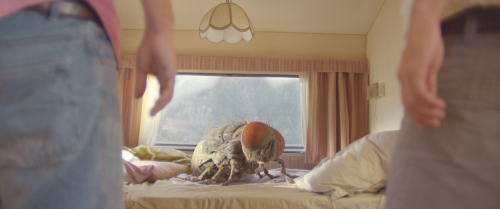
When Quentin Dupieux pitches a film, the producers get what they were promised. “Mandibles,” as the people who paid for it were no doubt happy to find, really is about two amiable French layabouts who discover a genuine giant red-eyed fly the size of a 10-year-old child in the trunk of a stolen car and who immediately consider training it to go and fetch things from the shops, rather than asking why the fabric of reality has sustained major damage. But reality is always a bit threadbare in Mr. Dupieux's tales, with their bleached daylight and vivid nonsense. His last film, “Deerskin,” steered the director's absurdist style into a darker lane, as a psychotic Jean Dujardin discovered his life's purpose in basic narcissism. The two guileless goons in “Mandibles” don't have a narcissistic thought in their heads, or indeed much else. They’re a blithe underclass, abandoned by the materialist world before and after something amazing happens. They're dumb and dumbeur.
Continue reading “A Bug’s Life” »
NonStop Entertainment
MOVIE REVIEW
Color Out of Space (2020)
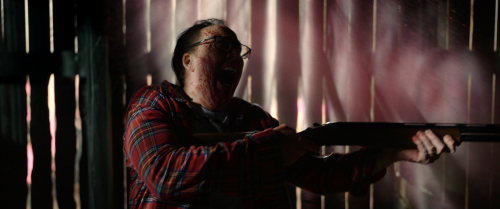
If you’re going to return to making feature films after 27 years away, you might as well pick up where you left off. The opening credits of “Color Out of Space” have Lavinia (Madeleine Arthur) carrying out a Wicca ritual, appealing to the angels to take care of her mother, and the words "Directed by Richard Stanley" appear over a close-up of the antique compass in her hand. Back in 1992 Mr. Stanley’s previous feature, "Dust Devil," started with another pilgrim looking at a hand-held totem; but then the figure was a supernatural serial killer and the item was a pocket watch going backwards. And back before that, the credits of “Hardware” ended with a post-apocalyptic scavenger dressed in the very 1990 boho-gothic style of Carl McCoy from the band Fields of the Nephilim (for it was he) holding another battered compass in equal close-up, although the credits on-screen at that exact instant are the freighted names of Bob and Harvey Weinstein. Three films, three nomads, looking at three antique analogue icons for some signal from a cosmos that shows every sign of being otherwise engaged.
Continue reading “Necronomicon Air” »
Parisa Taghizadeh/Sony Pictures Classics
MOVIE REVIEW
Final Portrait (2017)
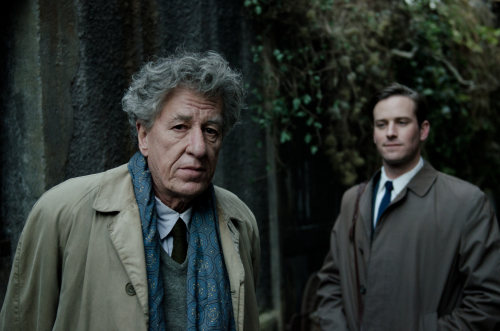
Stanley Tucci's fifth film as a director – and the first in which he doesn't appear himself – tells an episode from the late life of artist and sculptor Alberto Giacometti, a topic that clearly chimes with Mr. Tucci's long-standing interest in fine art and the turbulent urges that go into its creation. "Final Portrait" features Geoffrey Rush in full shambling dishevel as the 63-year-old Giacometti and Armie Hammer as James Lord, a younger American who sits for one of the artist's last works and starts to wonder if it will never actually be finished. The film has the utmost compassion for artists helplessly at the mercy of their own creativity and libido; and if its small scale keeps the external world mostly out of view, it at least believes the art to be worth all the internal aggro.
Continue reading “The Agony and the Effigy” »
Sundance Institute
MOVIE REVIEW
The Little Hours (2017)
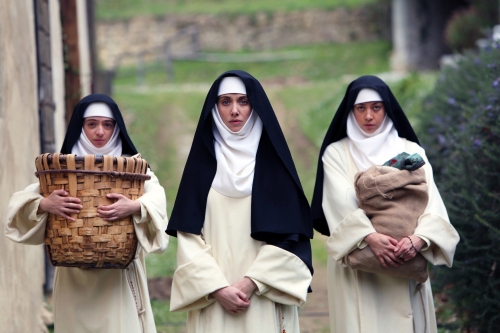
Watching Aubrey Plaza shout at people ranks high on my personal list of reasons to turn out for movies, only slightly behind the joys of Tracy Letts being cruel and vindictive. In “The Little Hours” she shouts and swears like a stevedore, a raucous deadpan dynamo restrained by a 14th century nun’s habit and wimple in the same way that a tin can constrains an atom bomb. Jeff Baena’s film transfers a bunch of thoroughly modern comics — Ms. Plaza, Molly Shannon, Nick Offerman, Kate Micucci, several others — to Middle Ages Tuscany with their vocal patterns and wry exasperations intact, for a tale sliced out of Giovanni Boccaccio’s “The Decameron” that drips with frustrated desire and the sins of the flesh. Hit or miss, it’s at least a reminder that American sex comedies weren’t always modern-dress bosses and bridesmaids, or offcuts from the Judd Apatow factory.
Continue reading “Nun of the Above” »
Studiocanal
MOVIE REVIEW
Free Fire (2017)
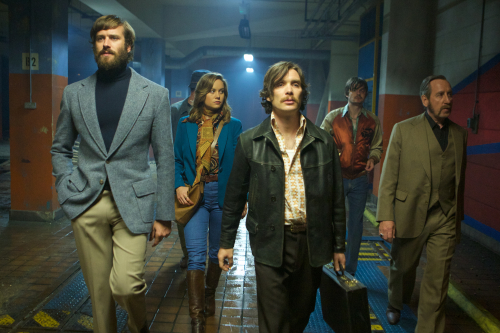
Obsessive readers of the small print, having spotted that Edgar Wright was an executive producer of Ben Wheatley‘s “Sightseers” and drawn some conclusions about that film’s intentions and wobbly rate of return, can go to town on “Free Fire” once the name of Martin Scorsese appears in the same capacity. It features a closed group of armed characters in a sealed location, a weapons deal that collapses in mistrust and sweary machismo, plus some ironic popular music on the soundtrack; so the director is hugging a certain strain of American crime story pretty tightly, at a time when that strain has become so naturalized as to have lost a lot of its virulence and surely all its surprise. Mr. Wheatley has a distinctive cinematic temperament, a very British high-altitude remove that on the domestic scene stands out so much that it might count as auteurist; but it isn’t the right tool for all jobs.
Continue reading “Crapshoot” »
Sydney Film Festival 2016
MOVIE REVIEW
The Commune (2016)
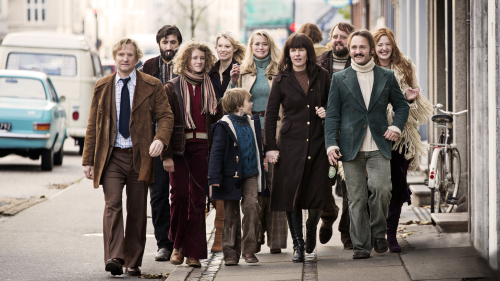
The Copenhagen of the 1970s lurked groovily over the horizon like a seven-day saturnalia to anyone peering toward the source of all the noise from the wrong side of the North Sea at the time. But Thomas Vinterberg revisits the environment of his childhood in “The Commune” and is careful to make it seem brittle, awkward and potentially corrosive to domestic harmony, full of the same misjudged fumblings toward happiness as everywhere else. Based primarily on a play by Mr. Vinterberg and Mogens Rukov and more distantly on the director’s own experiences, its characters are either helplessly insensitive or just hard of thinking, as well as adrift in an ocean of beige.
Continue reading “Peace, Free Love and Understanding” »
Magnolia Pictures
MOVIE REVIEW
Little Men (2016)
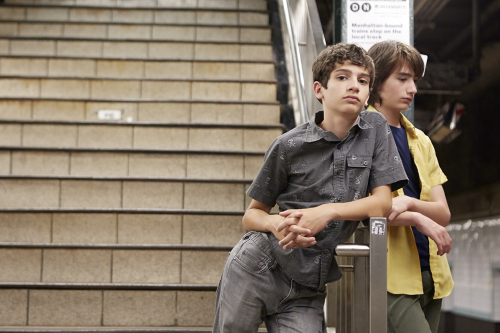
Ira Sachs’s “Love Is Strange” had moments of inspiration from top to bottom; but the most finely honed of all was the last one, when the story of two longtime companions in their 60s ended by drifting dreamily down the generations and following a pair of teenagers on a wordless glide through New York, skateboarding into a future of infinite possibilities. His new film “Little Men” starts with the relationship between two 13-year-old boys and looks up at the adult world of labor and gentrification from there, admitting that the possibilities might not be so infinite in practice. Life goes messily on anyway.
Continue reading “Boyhoods” »

2015 Busan International Film Festival
MOVIE REVIEW
The Virgin Psychics (2016)
Sion Sono’s gonzo gangster-cannibal-hip-hop fantasia “Tokyo Tribe” had its tongue in its cheek and death on its mind; “The Virgin Psychics” puts mortality to one side and gives Eros its day, but without feeling the need to calm down. Originally a manga by Kiminori Wakasugi (and already brought to TV by Mr. Sono in 2013 with a bunch of the same actors as here), it’s a relentlessly ribald sci-fi burlesque about a group of young virgins with shared prenatal connections who all acquire lascivious superpowers at the same time. They then get caught up in a particularly carnal version of the end of the world on loan from some cheapo 1970s porn parody – which for all the resulting difficulties certainly looks like more fun than the Midwich Cuckoos ever got up to.
Continue reading “Dickman & Throbbin Ride Again” »
2016 Sundance Film Festival
MOVIE REVIEW
A Flag Without a Country (2016)
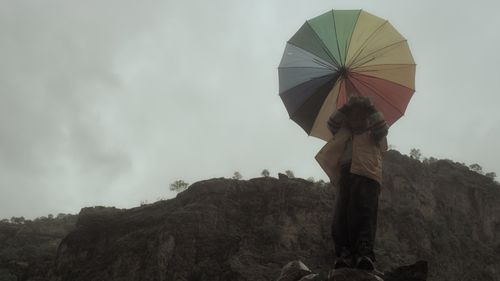
Bahman Ghobadi’s new sort-of documentary “A Flag Without a Country” declares itself to be scripted from the lives of its subjects, making it a spiritual cousin of “No One Knows About Persian Cats” – his 2009 film about two Iranian musicians trying to leave the country – which blurred the distinctions between invented characters and nonactors playing themselves into a continuous smudge. It worked then in urban Iran, and it works again now in beleaguered Kurdistan, where a much thinner helping of anything resembling a narrative is balanced by wider humanitarian concerns. “Flag” and “Cats” may share some kindred drollery, but it feels like Mr. Ghobadi has found a suitably fissile material for his method in the faces of Kurdish children scanning a horizon only just far enough away to conceal the ISIS fighters hurrying toward them, as if the interlocking sadnesses of northern Iraq were now dense enough for documentary truth to become bent by gravity on its way out.
Continue reading “It’s Time to Listen; It’s Time to Fight” »
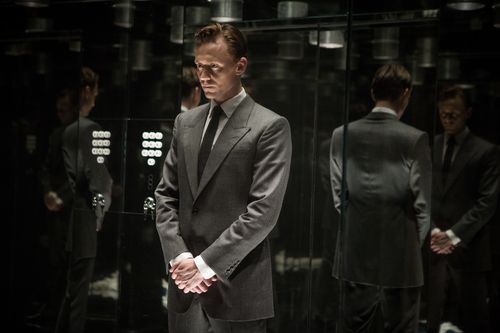
Studiocanal
MOVIE REVIEW
High-Rise (2016)
J. G. Ballard’s 1975 novel “High-Rise” famously cold-opens with a hot sentence about a dead dog; Ben Wheatley and Amy Jump‘s film adaptation opts to cut directly from the urbane sophisticate Robert Laing (Tom Hiddleston) glancing at the animal to the spit-roasting aftermath. The elision makes for a decent cinematic effect, showing not telling; but also sounds a warning shot about conventionality, a distilling down of Ballard’s haunted prose into nothing more adventurous than good old black humor. Mr. Wheatley’s taste for unsympathetic British grotesques also starts to crop up early before running rampant across the narrative by the end, joining a handful of Ballard’s dots about the inhabitants of the island without getting much of a grip on his social science.
Continue reading “Penthouse and Pavement” »