MOVIE REVIEW
Lebanon (2009)

The Film Society of Lincoln Center/
Celluloid Dreams
“Lebanon” — the newly-minted Golden Lion winner at the Venice Film Festival — is a personal account from director Samuel Maoz, who served in the Israeli army during its 1982 invasion of the eponymous nation now famous mostly for Hezbollah and rocket attacks. But a live-action “Waltz with Bashir” it is most certainly not. The film is in many ways so indistinguishable from “Beaufort,” an Oscar nominee for best foreign language film in 2008, that one constantly wonders what the Venice jury headed by Ang Lee saw in Mr. Maoz’s film that made it so special.
Continue reading “Cooped Up in a Tank, Running on Empty” »
MOVIE REVIEW
Police, Adjective (2009)

IFC Films
“The Death of Mr. Lazarescu” and “4 Months, 3 Weeks and 2 Days” have called worldwide attention to Romanian cinema. But they are tough acts for any film to follow, having set the bar impossibly high. So Corneliu Porumboiu faced an unenviable task. And given that both his debut, 2006’s “12:08 East of Bucharest,” and his follow-up, “Police, Adjective,” claimed awards at the all-important Cannes Film Festival, Mr. Porumboiu has obviously succeeded. But — unfair though the comparisons may be — his two films are nonetheless relatively underwhelming next to “Mr. Lazarescu” and “4 Months.”
Continue reading “Let’s Call the Whole Thing Off” »
MOVIE REVIEW
Vincere (2009)

Festival de Cannes
Marco Bellocchio has tackled some of Italy’s most delicate historical and religious subjects with an inspired touch of surrealism. “Good Morning, Night,” Mr. Bellocchio’s treatment of the Red Brigade’s 1978 kidnapping and murder of former Italian Prime Minister Aldo Moro, took that singular event and expanded it into a broader allegory of a turbulent chapter in Italian history. Similarly, “Vincere” extrapolates Benito Mussolini’s ill-fated first marriage into a cautionary tale about the price of absolute power.
Continue reading “Internee With Mussolini” »
MOVIE REVIEW
The Burning Plain (2008)
 Magnolia Pictures
Self-mutilation is now officially a cliché. It has become filmic shorthand to encapsulate within one scene years of psychological trauma visited on a person. It also seems quite redundant in the case of Sylvia, Charlize Theron’s character in “The Burning Plain,” who appears to be alarmingly promiscuous. If you also take into account the fact that it promises to be another one of those we-are-all-connected ensemble pieces, the film shapes up within the first 10 minutes to be a daunting task.
Continue reading “The Three Burials of Forbidden Love” »
MOVIE REVIEW
Paris (2008)
 Mars Distribution
Cédric Klapisch offered the definitive view of the City of Lights in 1996 with “When the Cat’s Away.” Starring mostly unprofessional actors from a deteriorating but ethnically diverse neighborhood, the film charmingly depicted a spirit of community enduring amid the changing times. It was infinitely more authentic than the obviously touristy treatments of the city such as that in “Amélie,” which went as far as digitally erasing graffiti on walls in a desperate attempt to create a romantic ideal that in fact does not exist.
Continue reading “Paris When It Fizzles” »
MOVIE REVIEW
Extract (2009)

Sam Urdank/Miramax Films
“I am the Great Cornholio! I need T. P. for my bunghole!” What in the world ever happened to Mike Judge, who supplied such 1990s cultural milestones as MTV’s “Beavis and Butt-Head” and blazed the trail for the likes of Ricky Gervais with “Office Space” before dropping off the radar of popular culture? Perhaps only his most diehard fans were aware of the unceremonious release of 2006’s “Idiocracy,” which 20th Century Fox dumped onto about 100 screens without advertisements or trailers. No matter, Mr. Judge is back, and we have to settle for that sorry excuse for comedy known as bromance no longer.
Continue reading “Trading Laugh Tracks for an R Rating” »
MOVIE REVIEW
The Headless Woman (2008)

Strand Releasing
An existential mystery about an amnesiac woman reorienting herself back to her world after sustaining a head trauma in a car accident, Argentine director Lucrecia Martel’s “The Headless Woman” challenges our perceptions of class, gender, profession, memory and the interpersonal relationships that collectively form our identities. Mesmerizingly sweeping and hazy, the film follows Verónica (María Onetto) as she attempts to fake her way back into her marriage, job and daily routines as if everything is just fine, thank you. We gather clues to her former self by watching her passively allowing everyone in her life to take the lead in every interaction. But while she seems to be successfully fooling her family, friends and colleagues, Verónica loses her grip on reality when she comes to believe that she has accidentally killed someone in the very car accident that erased her memory.
Continue reading “A Woman Under the Voidance” »
MOVIE REVIEW
Taxidermia (2006)
Here Media/Regent Releasing
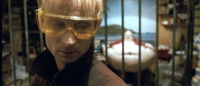
Based on short stories by Hungarian poet Lajos Parti Nagy, György Pálfi’s “Taxidermia” is a sweeping absurdist fantasy that spans three generations and half a century. Arriving in American theaters some three years after its premiere at the Cannes Film Festival, the film itself has traversed a similarly long and winding road. After wowing Tribeca festgoers in 2007, its domestic release was suddenly in limbo when its original distributor filed for bankruptcy.
Continue reading “The Stuff Extremes Are Made Of” »
MOVIE REVIEW
Lorna’s Silence (2008)
Christine Plenus/Sony Pictures Classics
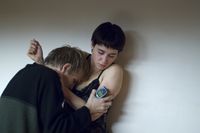
Jean-Pierre and Luc Dardenne have plenty of admirers as evidenced by their two Palme d’or wins. But their shtick is getting old, and they know it. So “Lorna’s Silence” marks a departure of sorts for the Belgian filmmakers, albeit one that doesn’t entirely work.
Continue reading “Waffling in a Belgian Conundrum” »
MOVIE REVIEW
Quiet Chaos (2008)

Chico De Luigi/IFC Films
Sandro Veronesi’s bestseller about a widower coming to terms with the accidental death of his wife serves as the basis for Antonello Grimaldi’s eponymous “Quiet Chaos.” But with Nanni Moretti scripting and starring, the film inevitably seems like an afterthought inspired by “The Son’s Room,” Mr. Moretti’s own much-lauded take on the grief process. The two films share thematic threads, but Mr. Grimaldi has extended every strand by a mile, including the tangential ones. Some manifestations of the mourning presented in “Quiet Chaos” do register as observant, while others strike as way off topic.
Continue reading “Good Grief Hunting” »