Sundance Institute
MOVIE REVIEW
Gail Daughtry and the Celebrity Sex Pass (2026)
David Wain’s first feature in eight years, “Gail Daughtry and the Celebrity Sex Pass,” arrives as a cheerfully indecorous homecoming — a return to the shaggy, ensemble-driven absurdism that once made his comedies feel like contraband smuggled into multiplexes. A sitcom-bright spoof of Americana that filters “The Wizard of Oz” through celebrity culture, the film is at once junk-drawer eclectic and curiously sincere about the small, stubborn dreams of its heroine.
Zoey Deutch plays Gail Daughtry, a former cheerleader and present-day hairdresser at the Tornado Salon, located in a Kansas town whose chief export appears to be inevitability. Gail’s life has been meticulously prewritten. She is engaged to Tom (Michael Cassidy), her childhood sweetheart and the former quarterback for the local high school; she has promised herself never to leave town; three empty picture frames hang on her wall, patiently awaiting the children she assumes will one day occupy them. Mr. Wain sketches this stasis with affectionate mockery, presenting Gail less as a rube than as someone who has mistaken the absence of options for certainty.
The title’s governing contrivance — the celebrity sex pass — is introduced with the bluntness of a punch line. Gail and Tom, in a show of enlightened marital pragmatism (or perhaps preemptive self-sabotage), have agreed that if either ever encounters their celebrity crush, infidelity is permitted, consequence-free. Fate, in the form of Jennifer Aniston, is not subtle. Playing herself, Ms. Aniston arrives in town for a cookbook reading that consists, deadpan and unabridged, of reciting ingredients and preparation steps to an enraptured crowd. Tom wastes no time cashing in his pass, and Gail catches them in the act.
What follows is not revenge so much as a warped attempt at equilibrium. Convinced that sleeping with her own celebrity crush is the only way to restore marital balance, Gail accompanies her co-worker Otto (Miles Gutierrez-Riley), a sweetly diffident dreamer, on a trip to Los Angeles. Otto is headed to an event hosted by Remi Fontaine (Michael Ian Black), known as the “king of whip curl;” Gail’s mission is to find Jon Hamm. This being a Wain film, the plan disintegrates almost immediately.
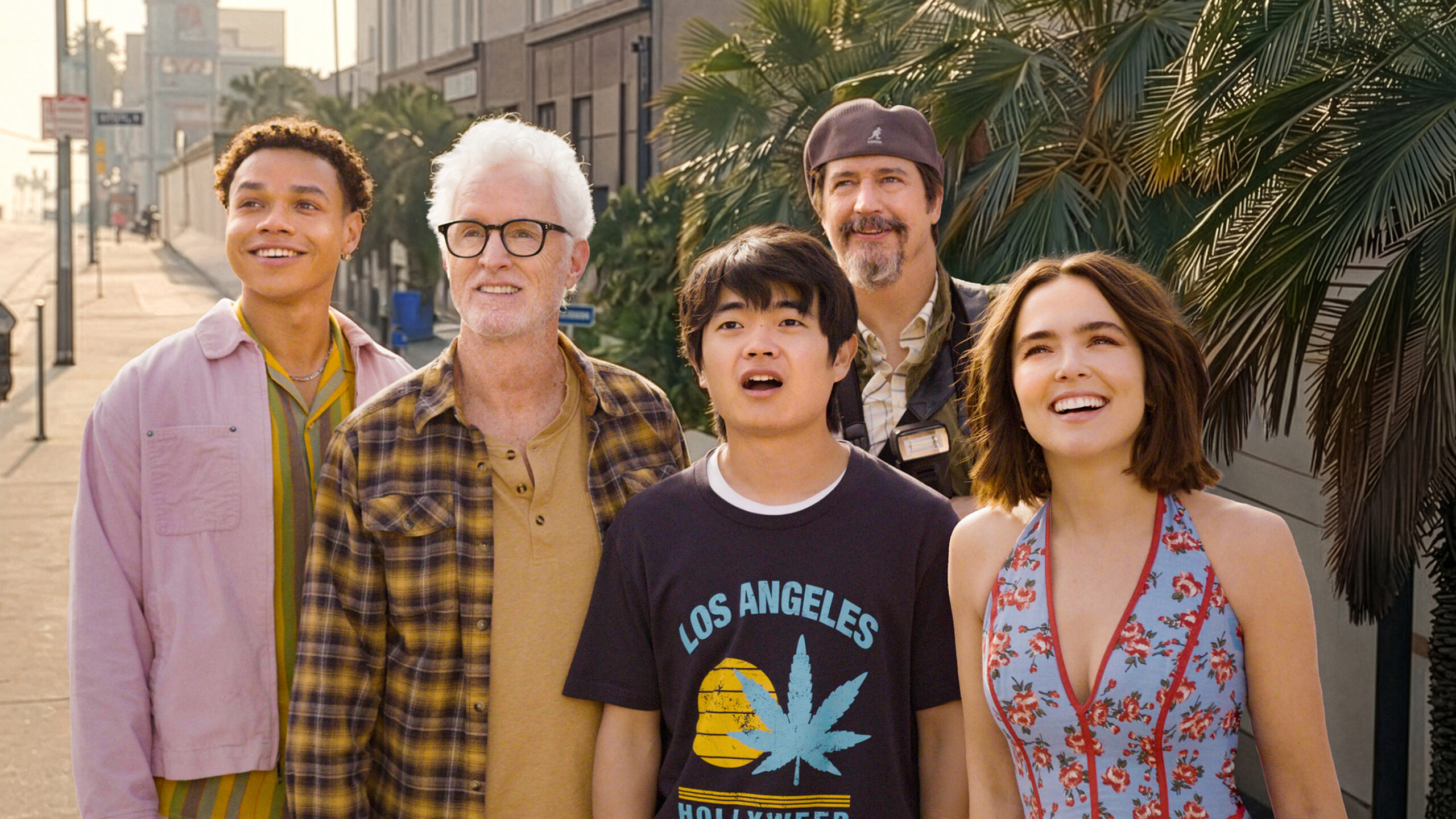
At LAX, two hapless goons (Joe Lo Truglio and Mather Zickel) accidentally swap luggage with Gail, dragging her and Otto into a byzantine plot to dismantle the global financial system. Hollywood becomes a yellow brick road paved with professional desperation and spiritual vacancy. Along the way, the pair encounter an overeager C.A.A. assistant (Ben Wang), a washed-up paparazzo (Ken Marino), and John Slattery, playing himself with louche self-awareness. These figures function, more or less, as the Scarecrow, Tin Man, and Cowardly Lion of Mr. Wain’s allegory, though the film treats such symbolism with willful sloppiness. This is Oz by way of Sunset Boulevard, where self-knowledge is optional and survival is mostly a matter of luck.
The humor is promiscuous and proudly undisciplined. Messrs. Wain and Marino, who co-wrote the script, never meet a joke they don’t feel compelled to try. A hotel concierge’s list of local attractions includes a McDonald’s, a Starbucks, and a Foot Locker with a backroom where one can score oral sex. Broad slapstick gives way, without warning, to bursts of cartoonish gore. Even viewers fluent in L. Frank Baum will find themselves unmoored; the pleasure comes not from guessing where the film is going but from marveling at how gleefully it refuses to choose a lane.
Ms. Deutch shoulders the chaos with impressive control. Gail is drawn as an exaggerated naïf — over-sheltered, relentlessly polite — which makes it all the funnier when her moral arithmetic begins to falter. The joke, ultimately, is not that Gail is foolish, but that she has been taught to treat desire as a ledger to be balanced rather than an impulse to be interrogated. Around her, the celebrity cameos function as both bait and commentary. Aniston, Slattery, Hamm, and Paul Rudd gamely puncture their own images, exposing the fragile scaffolding of charm and access that celebrity relies on.
By the time the film barrels toward its conclusion, it has become so extravagantly implausible that quibbling with its internal logic feels beside the point. “Gail Daughtry and the Celebrity Sex Pass” is not interested in coherence so much as momentum. It is a willfully mindless screwball comedy, but its escapism is not apolitical. In its insistence on silliness — on sex, spectacle, and stupidity — it offers a temporary suspension of dread, a two-hour permission slip to stop making sense of a world that increasingly refuses to do so itself.
Mr. Wain has made a film that stoops often and proudly, but never without purpose. Like its heroine, it wanders far from home only to discover that the real joke was the certainty it left behind.
Comments