MOVIE REVIEW
Starred Up (2013)

Sigma Films
British cinema has a long and distinguished tradition of prison dramas, from the slang-’n’-sodomy staple of Alan Clarke and Roy Minton’s “Scum” through to the more emotive exploration of Michael Winterbottom’s “Everyday.” Such a wearingly established genre has it become that prospective audiences could be forgiven for believing they really don’t need to watch another entry, but such an assumption would be badly misplaced. Director David Mackenzie and debut writer Jonathan Asser put a new spin on the genre that breaks free of the monotonous cycle of British social realism which always assumes that each new film has to be grimmer, tougher, meaner than all those that have gone before.
Continue reading “Father Figured” »
MOVIE REVIEW
Closed Curtain (2013)

57th BFI London Film Festival
Most people reading this will be aware of the backstory by now: Director Jafar Panahi has been under house arrest and banned from filmmaking since 2010 for supposedly inciting insurrectionary activities in Iran. “Closed Curtain” is the second film he’s managed to direct while under house arrest (with the collaboration of Kambuzia Partovi) and again managed to miraculously smuggle out of Iran for the benefit of international audiences.
The first one was “This Is Not a Film” (made with a different co-director, Mojtaba Mirtahmasb), and the early opinion on “Closed Curtain” seems to be that Mr. Panahi’s second attempt isn’t as interesting as the first. The novelty has worn off! The fact that such a fascinating film could be taken for granted in such a way suggests much about the impossibly high standards to which Iranian cinema is now held. We all, after all, have our expectations from Iranian cinema, which include in no particular order: the intermingling of documentary and narrative and resulting metatextual complexity, bold Brechtian devices, startlingly feminist viewpoints, sensational performances from amateur child actors, closeted allegories about Iranian society, submerged critiques of the ruling clerical elite and — if possible — all of the above conveyed with an unusual degree of heart, warmth and universality.
Continue reading “Banished for Life” »
MOVIE REVIEW
Homefront (2013)

Justin Lubin/Open Road Films
In many ways a movie is all about timing. What seems like a good hook when a script begins doing the rounds can lose its freshness by the time it makes the screen. And of course the trouble is television has gotten so good lately, it can be almost impossible for movies to keep completely separate identities. But “Homefront” is particularly unlucky, since it comes across as a mash-up of the two most distinctive settings of recent long-form television: “Breaking Bad” set in the world of “True Blood.”
Continue reading “Braking Bad” »
MOVIE REVIEW
The Fifth Estate (2013)

Frank Connor/Walt Disney Studios
Julian Assange's pre-emptive attempt to persuade Benedict Cumberbatch not to play the WikiLeaks founder in "The Fifth Estate" was probably a forlorn hope. As if Mr. Cumberbatch, now deep into that period when stars can be seen still visibly enjoying the work, was likely to refuse the opportunity of investigating a character as confounding and mannered as Mr. Assange. The actor's talent for mimicry has been put to good use before, but Bill Condon's film allows him to deploy it on a higher level altogether, and the results are a firework display. It's not his fault that the film comes not long after Alex Gibney's documentary "We Steal Secrets: The Story of WikiLeaks," which covered some of the same ground in more eccentric and inventive fashion, and did so with a harder focus on Mr. Assange than "The Fifth Estate" can pull off.
Continue reading “Publish and Be Slammed” »
MOVIE REVIEW
Her (2013)

Warner Brothers Pictures
These days, neither Spike Jonze nor Charlie Kaufman seems to have much fun working apart from the other. At first glance, the premise of Mr. Jonze’s “Her” suggests a return to zany form following “Where the Wild Things Are”: The new film concerns Theodore (Joaquin Phoenix), a BeautifulHandwrittenLetters.com writer who is in the midst of a divorce and developing romantic feelings toward Siri version 20.0, here known as Samantha (voiced by Scarlett Johansson). While parts of it are hilarious just as one would expect, the rest of the film takes on a surprisingly somber tone.
Continue reading “Your Wish Is Its Command” »
MOVIE REVIEW
The Congress (2013)

57th BFI London Film Festival
A divisive entry in Cannes Director’s Fortnight back in May and now a polarizing presence at 57th BFI London Film Festival, Ari Folman’s almost dementedly ambitious film could well antagonize some viewers with its scattershot approach to a variety of 21st-century concerns, from modern culture, to science, technology, aging and more. But for its sheer audacity and willingness to approach both philosophical concepts and a bewildering animation style, I’d argue it’s a film to be dissected and admired.
Continue reading “Being Robin Wright” »
MOVIE REVIEW
Jeune & jolie/Young & Beautiful (2013)

57th BFI London Film Festival
Prolific, dependable and remarkably consistent, François Ozon has built up an impressive body of work since his arrival onto the cinematic scene more than 20 years ago. His latest film certainly suffers in comparison to its predecessor, “In the House,” now seen as one of Mr. Ozon’s strongest and most successful works. But while “Jeune & jolie/Young & Beautiful” may be modest and even frustrating, it would probably be seen as a highly creditable drama from most other talents.
Continue reading “A Seasoned Paramour” »
MOVIE REVIEW
Like Father, Like Son (2013)

Sundance Selects
Family lies at the center of much of Hirokazu Kore-eda’s work. It’s at once the most personal and familiar subject matter, but is one that is riddled with nuance and unbounded complexity. Nature versus nurture is a story as old as the hills, but rarely has it been told with such heartfelt craft as in Mr. Kore-eda’s latest picture, “Like Father, Like Son.”
Continue reading “Life Swap” »
MOVIE REVIEW
Ida (2013)

38. Gdynia Film Festival
Anna (Agata Trzebuchowska) is a young nun on the brink of taking the vows that will sequester her from the world indefinitely. Her mother superior (Halina Skoczynska) generously advises her that she may want to connect with her only known living relative before being cloistered, so Anna subsequently acquaints herself with Wanda (Agata Kulesza), a hard-drinking, straight-talking 40-something dropout.
In the process Wanda reveals that Anna is in fact Ida, a Jew who was left on the convent’s doorsteps amidst the carnage of World War II. Thus begins a road movie in which two strikingly different characters embark on a journey of discovery, uncovering facts about their family history which have been concealed up by years of guilt, denial and obfuscation.
Continue reading “The Sisterhood of the Traveling Aunt” »
MOVIE REVIEW
Walesa: Man of Hope (2013)
57th BFI London Film Festival
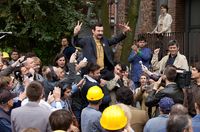
The latest film from the remarkable 87-year-old Polish director Andrzej Wajda is ostensibly the conclusion to a trilogy of films about the ascendance of the Solidarity movement in late 20th-century Poland, a project which began back in 1977 with “Man of Marble.”
The first film in the series charted the emergence of a (fictional) socialist folk hero, Mateusz Birkut (Jerzy Radziwilowicz), a record-breaking bricklayer who would fall out of favor with the authorities before being gunned down in the (very real) workers’ uprising massacres of 1970. That traumatic incident would go on to inspire both Birkut’s son, metalworker Maciej Tomczyk — titular character in the 1981 film “Man of Iron” also played by Mr. Radziwilowicz) and the burgeoning Solidarity movement as it took hold across industrial Poland during the 1980s.
The final film in the series turns attentions to a real-life figure, Solidarity’s leader Lech Walesa (played by Robert Wieckiewicz in the film), who rose from a life of laborer’s anonymity to become not just the head of Solidarity’s hierarchy but also Poland’s first democratic president. The film charts his unlikely evolution from relatively unrefined hardhead to a charismatic and forthright figurehead, whose plain-speaking and brute obstinacy would see him inherit the role of shepherding Poland into a new post-Soviet era.
Continue reading “Spit and Polish” »