La Biennale di Venezia
MOVIE REVIEW
Our Land (2026)
I first encountered Lucrecia Martel’s “La ciénaga” during its theatrical release in 2001, primed by the high praise of critics I trusted, who framed the film as a study of the moral and social decay of Argentina’s bourgeoisie. That reading seemed persuasive at the time; the languor, the drunkenness, the air of stagnation, all pointing toward a class in quiet disintegration. Revisiting the film 24 years later, at a repertory screening, I found myself arriving at a markedly different conclusion. What once struck me as a portrait of decline now appears as something more foundational and more unsettling: a film permeated, above all, by the afterlives of colonialism.
The realization was not gradual. It presented itself with a kind of immediacy, as if the film had shifted beneath me while remaining exactly the same. By the time a fellow attendee challenged this interpretation during the post-screening Q. & A.—which featured Jens Andermann, the author of “New Argentine Cinema”—I had already committed to it internally. Mr. Andermann, for his part, argued along similar lines, situating Ms. Martel’s work within a broader historical continuum shaped by colonial structures and their persistence. It was clarifying to hear the idea articulated so plainly, though it hardly required my endorsement.
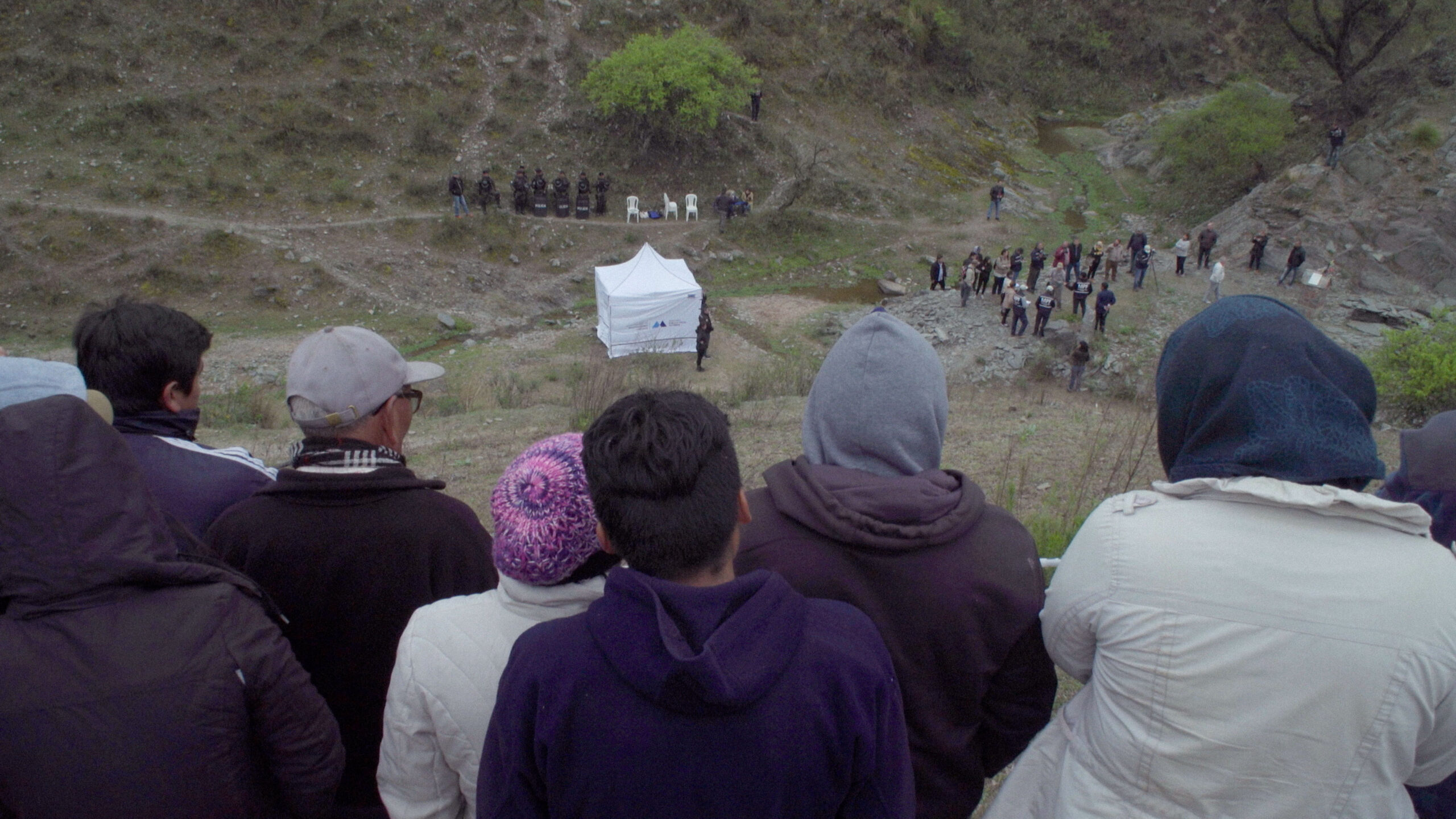
A few months earlier, I had seen Ms. Martel’s latest film, “Our Land” (which premiered at the Venice Film Festival under the English title “Landmarks”), and in retrospect it feels less like a departure than a culmination. The documentary centers on the murder of Javier Chocobar, a member of the Indigenous Chuschagasta community, who was killed by landowner Darío Amín during a dispute over territory. The case is specific, contemporary, and devastatingly concrete; yet it also resonates as part of a much longer history of dispossession. When considered alongside “Zama” (2017), Ms. Martel’s austere and hallucinatory period film about a colonial functionary stranded on the periphery of empire, a thematic through line becomes difficult to ignore. Colonialism, and its enduring psychic and material consequences, has not merely hovered at the edges of her work—it has been central to it.
“Our Land” announces its concerns with striking economy. Early in the film, Ms. Martel juxtaposes grainy cellphone footage of the murder—captured in the chaos of the moment—with a more composed sequence in which Amín walks the police through the crime scene. The contrast is both aesthetic and moral. The immediacy of the handheld recording, with its unstable framing and unfiltered urgency, collides with the measured, almost procedural calm of the reenactment. This tension echoes Ms. Martel’s fiction films, though the tools here are different. Where her earlier work often relied on carefully orchestrated soundscapes and oblique visual compositions to evoke unease, “Our Land” draws on the raw textures of widely accessible technology. Yet the effect is no less deliberate. Ms. Martel remains acutely attentive to how images—and the conditions under which they are produced—shape our understanding of reality.
Sound, as ever in her cinema, plays a crucial role. Testimonies are layered over images of the landscape and the investigation, creating a disjunction between what is seen and what is heard. The result is not confusion but emphasis: a reminder that the official version of events, embodied by institutions, rarely aligns with the lived experiences of those most affected. By displacing these voices from the visible frame, Ms. Martel underscores the systemic marginalization they endure.
The film also makes a point of dwelling, quietly but insistently, on the textures of Chocobar’s life. Family members leaf through photo albums, recount memories, and reconstruct a presence that might otherwise be reduced to a legal abstraction. These moments are disarmingly intimate, and they serve a clear purpose. The Chuschagasta community emerges not as a distant or romanticized “other,” but as recognizably human—warm, complex, and rooted in a shared history. This makes the subsequent legal proceedings feel all the more chilling.
In the courtroom, the imbalance of power becomes stark. Amín, aligned with figures who project authority and respectability, is defended by a lawyer whose aggressive tactics verge on intimidation. The asymmetry extends beyond demeanor. It is embedded in language, in access, in the very structure of the institutions meant to adjudicate justice. Ms. Martel does not need to editorialize heavily; the disparities speak for themselves. At one point, the defendants object to the presence of the documentary crew, as if the act of being observed constitutes an infringement on their rights. The irony is difficult to miss. A system that has long rendered indigenous communities invisible suddenly recoils at the prospect of scrutiny.
Layered into this is the specter of misinformation. A piece of journalism cited in the case falsely claims that the Chuschagasta people have long been extinct—a narrative that conveniently erases their claims to the land. It is a reminder that colonial violence is not only physical but epistemic: it operates through the control of narratives, the distortion of history, and the denial of presence.
To call “Our Land” a “true-crime documentary” is accurate but insufficient. The film is concerned less with solving a mystery than with exposing a structure. The murder of Chocobar is not an aberration; it is an expression of a system that continues to privilege certain lives over others. Ms. Martel’s achievement lies in her refusal to isolate the incident from its broader context. She situates it within a continuum that stretches back centuries, implicating not just individuals but the frameworks that enable them.
One case, of course, cannot stand in for the entirety of the Americas’ colonial history. It does not pretend to. Yet it offers something that abstraction often cannot: a point of entry, a way of seeing how large-scale injustices manifest in specific, lived realities. In this sense, the film functions as both document and provocation.
Thinking back to that repertory screening of “La ciénaga,” I am struck by how much this newer work reframes the earlier one. The decay I once perceived now seems inseparable from a deeper, historical rot—a legacy that continues to shape the present in ways both visible and obscured. Had the skeptical audience member at that screening seen “Our Land,” he might have been less inclined to dismiss the colonial dimension of Ms. Martel’s cinema. Or perhaps he would have taken issue with the filmmaker herself. It is difficult to say.
What is clear is that, with “Our Land,” Ms. Martel has created a film of considerable force—one that centers indigenous perspectives without reducing them to symbols, and that confronts the viewer with the persistence of injustice. Whether it can catalyze tangible change is an open question. But as a work of cinema, it insists—quietly, rigorously—on the necessity of looking, and of listening, more closely.
Comments