Lenke Szilagyi
MOVIE REVIEW
Silent Friend (2026)
Following a long-overdue first brush with Hollywood visibility—albeit in the supporting architecture of a Marvel franchise (“Shang-Chi and the Legend of the Ten Rings”)—Tony Leung Chiu-wai (not to be confused with his namesake, Tony Leung Ka-fai) takes on another English-language role under markedly different auspices. In place of spectacle, there is reticence; instead of green-screen maximalism, a hushed, faintly metaphysical inquiry. The film, directed by Ildikó Enyedi, whose “On Body and Soul” paired abattoir realism with dreamlike lyricism, unfolds as a triptych of botanical fascination, tenuously bound across time by a single organism: a ginkgo biloba tree rooted in the grounds of a German university.
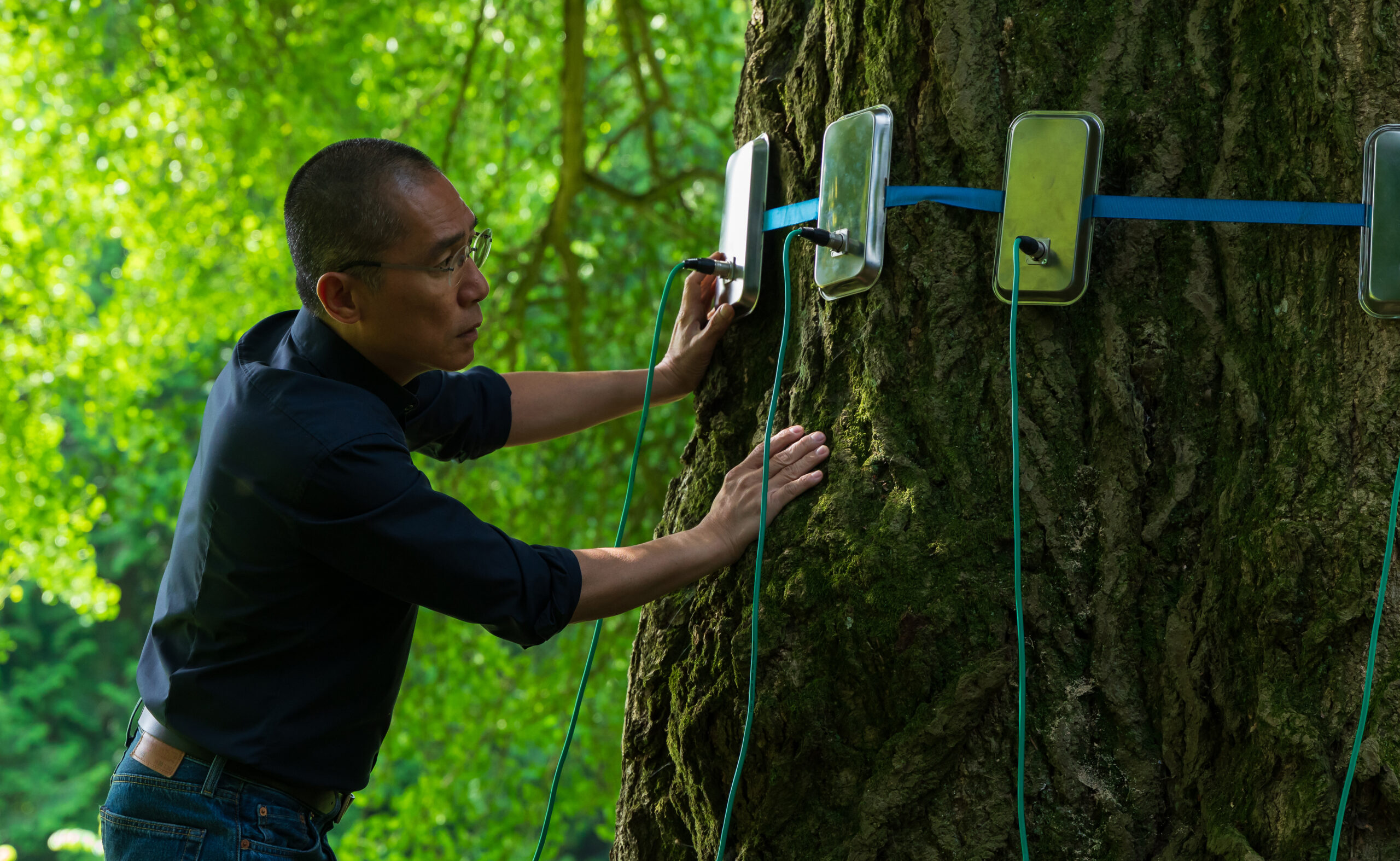
Mr. Leung plays Tony Wong, a neuroscience professor whose professional life is divided between the study of infant cognition and a sideline in the delicate restoration of stuffed animals used in research. The detail is not incidental. There is something quietly emblematic in the way he stitches together these surrogate bodies—objects of comfort, proxies for emotional attachment—suggesting a temperament inclined toward care. When he accepts an invitation to collaborate with researchers at Philipps-Universität Marburg, the project centers on a question that hovers somewhere between science and speculative philosophy: can a tree be said to possess consciousness? The film poses the question with academic caution, but only provisionally.
The arrival of the Covid-19 pandemic strands Professor Wong on campus just as the institutional rhythms collapse into eerie stillness. Ms. Enyedi renders the emptied university as a contemplative vacuum, a space in which observation begins to shade into belief. Professor Wong wanders through corridors and gardens with a tentative, almost apologetic physicality, as though wary of disturbing a presence he cannot quite define. Over time, however, the film relinquishes its initial ambivalence. What begins as inquiry resolves into conviction: the ginkgo is not merely an object of study but a subject in its own right, endowed with a form of sentience that the human characters, haltingly and unevenly, come to recognize.
The narrative doubles back to 1908, when a young woman named Grete, played with restrained determination by Luna Wedler, becomes one of the first women admitted to the university’s botany department. Her storyline unfolds in a visual register that leans toward the monochromatic, with a grainy texture suggestive less of historical reconstruction than of memory under strain. Exclusion and curiosity coexist in her experience, and her attention to plant life carries the faint suggestion of an affinity not yet fully articulated.
A third strand, set in 1972, follows Hannes (Enzo Brumm), a farm-raised young man whose intellectual awakening is catalyzed by his temporary custodianship of a potted geranium. The plant belongs to Gundula (Marlene Burow), a researcher investigating the possibility of emotional reciprocity between humans and flora—a premise the film treats not as eccentric but as emergent knowledge. Mr. Brumm plays Hannes as a figure suspended between skepticism and dawning attunement, his engagement with the geranium less a revelation than a slow recalibration of perception.
The triptych structure invites comparison across eras, though the connections are more atmospheric than causal. The ginkgo tree serves as an axial presence, its continuity contrasting with the fragmentary human stories that unfold around it. Ms. Enyedi’s interest lies in accumulation: the suggestion that acts of attention—scientific, emotional, or otherwise—might converge across time into something like understanding.
It is here that the film finds an unexpected parallel in “In the Blink of an Eye,” another recent work preoccupied with duration, perception, and the place of human consciousness within a broader, nonhuman continuum. Both films adopt a contemplative tempo and a visual grammar built from stillness, soft focus, and ambient sound; both aspire to a kind of secular transcendence grounded in observation rather than narrative propulsion. Where they diverge is less in method than in reception. Ms. Enyedi’s film, with its period textures and festival pedigree, has been afforded a seriousness that the other, burdened by its streaming provenance, was often denied. Yet the resemblance is difficult to ignore. In each case, the risk is the same: that a commitment to stillness and abstraction may be mistaken for depth, or, conversely, that viewers inclined toward such modes will find in them a rarefied kind of rigor.
Mr. Leung, for his part, occupies an uneasy position within this framework. His screen presence—so often defined by a combination of emotional opacity and sudden, piercing vulnerability—is here muted to the point of near-erasure. The role does not so much miscast him as fail to imagine what he might bring to it. There are moments—a flicker of curiosity, a fleeting weariness—when one glimpses the actor’s capacity to suggest entire inner lives with minimal gesture, but these moments are not developed. The performance feels less like an interpretation than like a component within a conceptual design.
Léa Seydoux, in an even smaller role, is afforded still less to do, her presence registering more as a marker of international co-production than as a fully integrated element of the film’s emotional ecology. That both actors of such distinct charisma should be rendered almost interchangeable speaks to the film’s prioritization of idea over embodiment.
And yet, for all its conceptual rigidity, “Silent Friend” exerts a certain lingering pull. Its images have a way of settling in the mind: the texture of bark against winter light, the stillness of an abandoned library, the fragile proximity of a human figure to a nonhuman presence that neither acknowledges nor rejects it. The film’s central assertion—that plants are not passive background but sentient participants in a shared world—is delivered not as a provocation but as a quiet fait accompli. Whether one finds this persuasive or merely programmatic may depend on one’s tolerance for abstraction untethered from dramatic momentum. The film asks for patience, and offers, in return, a kind of meditative drift—one that remains, even as it risks mistaking stillness for revelation.
Comments