Anthony Dickenson/Studiocanal
MOVIE REVIEW
Ink (2026)
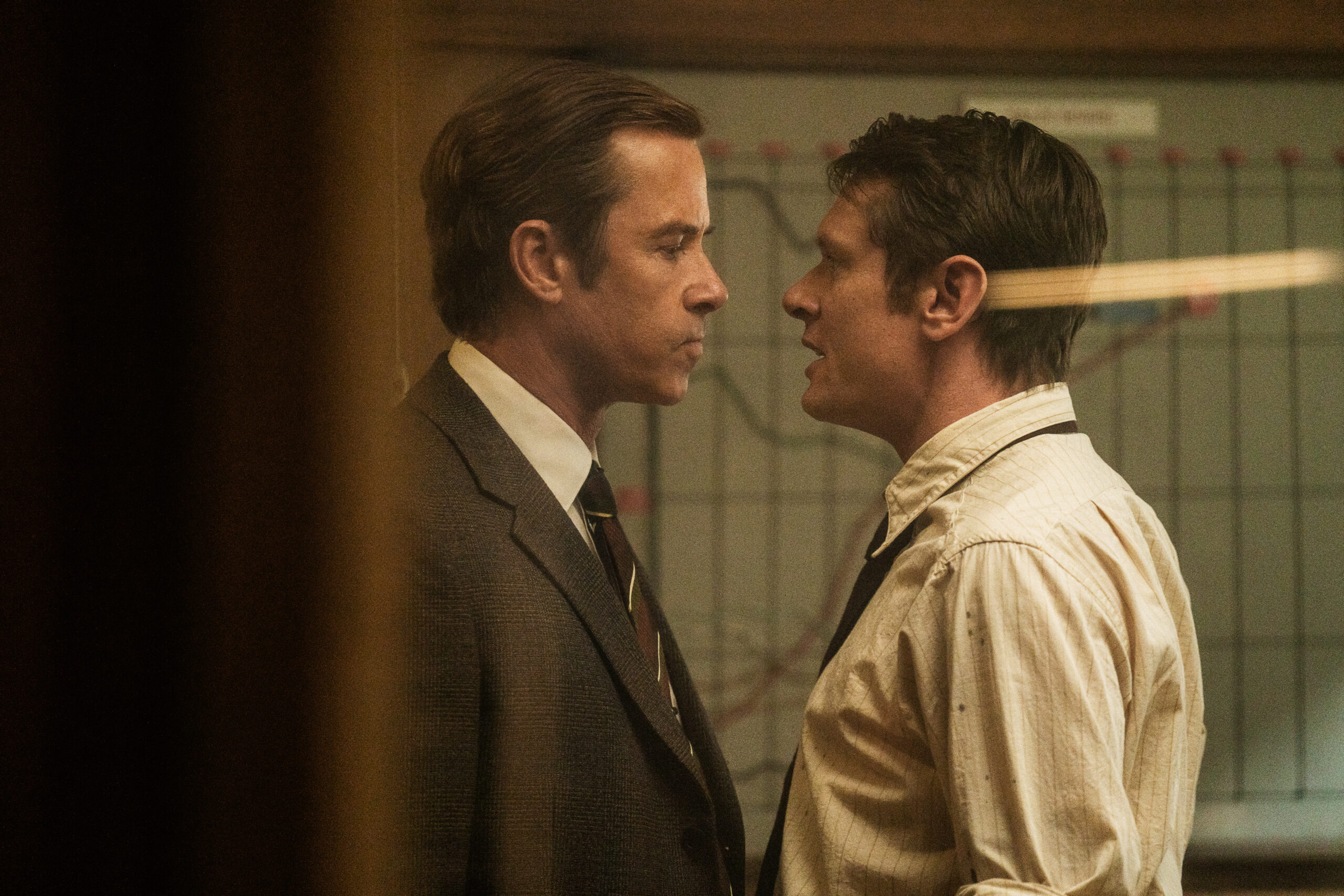
Danny Boyle’s “Ink,” opening at the 83rd Venice Film Festival, offers what may be the most incisive screen portrait yet of Rupert Murdoch — not necessarily because it reveals anything new about the man, but because it understands the peculiar mixture of grievance, ambition, opportunism, and showmanship that has sustained his media empire. The predominantly European-backed production occasionally feels like Hollywood keeping its distance from a mogul whose influence remains difficult to ignore. Yet Mr. Murdoch, played by Guy Pearce in a stroke of inspired casting that reportedly has the mogul’s own approval, is not even the film’s most frightening figure. That distinction belongs to Jack O’Connell’s Larry Lamb, the northern editor of the Daily Mail in Manchester, whom Mr. Murdoch tapped to run the newly acquired Sun in October 1969. Mr. Murdoch may have provided the money and the vision; Lamb supplied the appetite.
Mr. Boyle announces the film’s sensibility almost immediately. The opening images transform the printed newspaper into something kinetic and unstable: stippled illustrations, typography, and fragments of ink give way to the filmed world, as though the people inside the story have been conjured from the pages themselves. We then find Mr. Murdoch making Lamb an offer he cannot refuse over plates of shrimp on a Friday night at the Savoy Grill, the see-and-be-seen restaurant off London’s storied Fleet Street. It is an appropriately theatrical introduction to a story about people who understand that newspapers are not merely meant to report but to perform.
Mr. Murdoch, an Australian in a British media establishment that regards him as an outsider, has spent his career converting condescension into fuel. His resentment of snooty British elites becomes indistinguishable from his determination to defeat them on their own turf, and Mr. Boyle’s film suggests that Lamb recognizes the feeling immediately. Lamb had also felt overlooked at the Mirror prior to the Daily Mail and saw little future for himself there; Mr. Murdoch’s offer presents an irresistible opportunity to turn professional humiliation into professional triumph. Their bond is founded on something more potent than ideology: they both know what it is to believe that the room has been designed to keep them out.
For both men, success is business, but it is also revenge.
Lamb sets about assembling a staff from the overlooked and underappreciated journalists of Fleet Street, building a scrappy operation with the explicit ambition of taking the Sun from a down-market newspaper to the most widely read paper in Britain. The editorial philosophy is simple enough to sound almost innocent: give readers what they actually want rather than what the establishment thinks they ought to want. Boxing, television, weather, horoscopes, crime, sex, and topless women begin to replace the conventions of respectable journalism. The Sun’s genius, in this telling, lies not in discovering that people are interested in such things, but in understanding that there is enormous power in telling readers that their supposedly disreputable interests are more important than the interests of the people who look down on them.
Mr. Boyle makes the creation of this newspaper feel like the creation of a band. His stylistic flourishes are most evident in the early scenes recalling the restless visual grammar of “Trainspotting”: bold italic sans-serif titles, the stippled animation, abrupt transitions, and a succession of choices that sometimes seem designed less to advance the story than to give it the exhilaration of a startup running on amphetamines and bad judgment. Some of these devices are explicitly newspaper-inspired; others are deliberately chaotic. Together, they capture the intoxicating feeling of an institution being invented in real time, when breaking rules feels like innovation rather than the harbinger of a business model.
That distinction is crucial. Every media startup imagines itself as a revolution until someone has to live with the consequences.
The film is especially perceptive about the relationship between editorial experimentation and personal resentment. Lamb’s methods are hardly born from nowhere. Even before he begins reshaping the Sun, his moral character is placed under scrutiny through his affair with Jules Davies (Claire Foy), a former colleague at the Mirror whom he is simultaneously trying to recruit. He is already a man who treats professional and personal boundaries as obstacles to be negotiated rather than principles to be observed. The newsroom he creates consequently feels less like a departure from his character than its institutional expression.
There are moments, to be sure, when the Sun’s insurgency looks almost admirable. The paper refuses the stiff conventions of Fleet Street and recognizes the entertainment value of subjects that respectable editors have traditionally treated as beneath them. Lamb’s journalists understand that circulation is not an abstraction: it is a measure of whether people are actually reading. But Mr. Boyle and screenwriter James Graham, adapting Mr. Graham’s own play, are interested in the moment when populism ceases to mean taking ordinary readers seriously and begins to mean exploiting their appetites.
The Muriel McKay case supplies that turning point.
McKay (Lucy Russell), the wife of Murdoch’s deputy, Alick (Jonathan Hyde), was abducted after being mistaken for Mr. Murdoch’s wife, Anna. What begins as a terrible crime becomes, in Lamb’s hands, an opportunity. Under the pretext of pursuing information about the kidnapping, he recklessly pushes the Sun toward increasingly sensational coverage, jeopardizing the investigation in the process. Circulation rises. The paper gets what it wants. And the reader is invited to contemplate the oldest bargain in mass media: the more horrible the event, the more valuable the story becomes.
It is here that “Ink” ought to slow down, but Mr. Graham’s screenplay chronicles the episode with a somewhat conventional briskness. The film is more interested in the momentum of the Sun’s ascent than in the moral weight of the machinery that powers it. The kidnapping should feel like the moment when the paper’s populist energy curdles into something darker, when the logic of giving readers what they want becomes indistinguishable from manufacturing what they cannot look away from. Instead, the film moves through the episode almost as another milestone in the newspaper’s development.
And yet one of the film’s sharpest observations comes from Mr. Murdoch himself. Even this soulless ghoul, whose empire has been built on the monetization of outrage, appears to recognize that Lamb has crossed a line. Mr. Murdoch ultimately rewards his editor’s spectacular success by exiling him to Australia — a punishment that is also, in its way, a promotion, or at least another opportunity to expand the franchise. The irony is perfectly Murdochian: the man is punished not for failing, but for succeeding too completely.
Mr. Pearce plays Mr. Murdoch with an unnerving restraint. He does not need to bellow or menace because the character’s power comes from his ability to make other people discover their ambitions inside his own. Mr. O’Connell’s Lamb, by contrast, is all movement and appetite. He is the kind of man who can make recklessness look like courage and vulgarity look like authenticity. The casting captures the film’s larger argument: Mr. Murdoch does not have to be the monster in every room because he knows how to identify people who are willing to become monsters on his behalf.
This is ultimately what makes “Ink” more revealing than a conventional media-industry drama. It is not really a story about the birth of a newspaper. It is a story about a method. Mr. Murdoch learns that a media organization can turn resentment into loyalty, scandal into circulation, and the public’s appetite for spectacle into a form of political and cultural power. The Sun is simply the laboratory in which the formula is refined.
The film’s epilogue makes that lineage explicit, connecting the newspaper’s unruly birth to the far larger empire that would follow, from the New York Post to Fox News. What looked in 1969 like a brash experiment in tabloid publishing eventually became a blueprint for an entire conception of media: give people an enemy, tell them they are smarter than the people who disapprove of them, and make the resulting anger profitable.
The most unsettling thing about “Ink” is therefore not that Mr. Murdoch created a monster. It is that the monster already knew what people wanted.
Comments