The Guardian
MOVIE REVIEW
NAZA (2026)
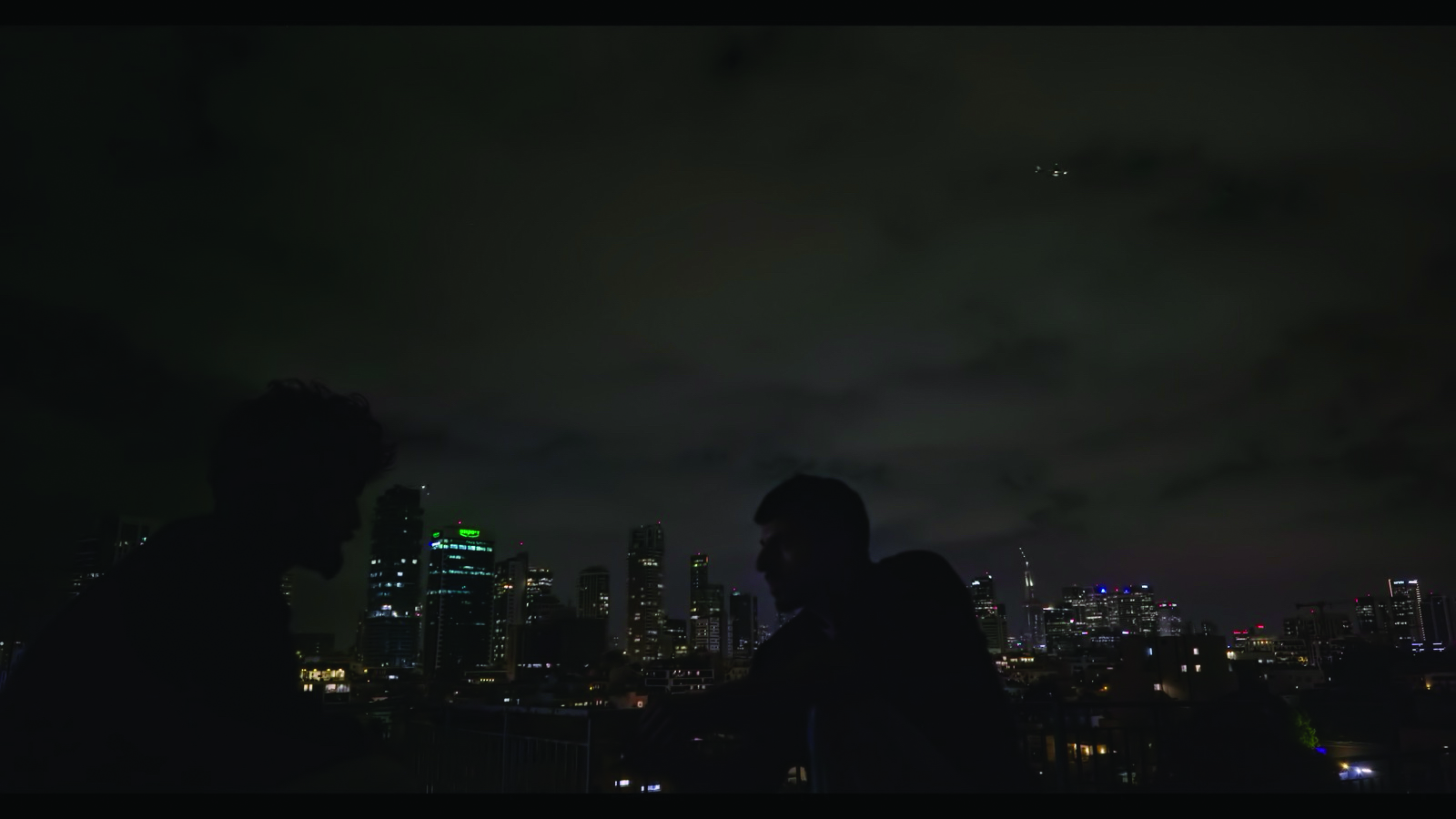
A rare documentary in the Venice Film Festival competition, “NAZA” is the latest film from Yuval Abraham and Rachel Szor, two members of the directing team behind the Oscar-winning “No Other Land.” Their new film returns to the genocide in Gaza, but approaches it from an unnerving vantage point: inside the Israeli intelligence apparatus responsible for carrying it out. Mr. Abraham and Ms. Szor assemble testimony from roughly two dozen Israeli intelligence officers, all of whom speak anonymously. Their identities are protected not only by digital alterations to their voices, disclosed at the outset, but by the film’s striking visual conceit: the men and women appear as silhouettes against the nighttime Tel Aviv skyline, their faces reduced to anonymous outlines.
The effect is at once protective and accusatory. The silhouettes make the interviewees nearly indistinguishable from one another, as if they were pieces of the same machinery, while their testimony insists on the opposite: they are not a monolith. Some express remorse; one renounces his own complicity; another admits that he has not yet “come around.” One interviewee explicitly calls Israel’s assault on Gaza a genocide, without the qualifying language that so often accompanies discussion of it. Another insists that most members of his unit are not Arab-haters, contrary to what he imagines is the public perception of Israeli intelligence personnel. Their differences matter, but so does the fact that they are all speaking from within the same system.
Often, the interviews become voice-over narration as the camera moves through Tel Aviv at night, peering through windows to capture fragments of domestic life. There are living rooms, television sets, the banal rituals of a city settling down for the evening — and, again and again, Benjamin Netanyahu appearing on those screens. The device is perversely voyeuristic, but it is also perfectly suited to a film about surveillance. The filmmakers are essentially watching the watchers, turning the domestic interiors of Tel Aviv into a visual echo of the intelligence operations being described. The interviewees recount listening in on the telephone conversations of suspected Hamas operatives; the film, in turn, listens in on the lives of Israelis who remain largely unaware of what is being done in their name.
What emerges from these testimonies is perhaps more disturbing than the image of an indiscriminate military campaign alone: the extent to which civilian death has been transformed into a problem of administration. Israeli intelligence identifies alleged Hamas members, determines where they live, and then targets their homes, even when women and children are present. The film’s title refers to a Hebrew military acronym associated with calculations of anticipated civilian casualties in airstrikes. The language is clinical, almost bloodless. Death becomes a number entered into a calculation, an acceptable cost attached to a target.
The artificial-intelligence system known as Lavender, used to help identify suspected Hamas operatives, only deepens the unease. Quantity takes precedence over precision; the machinery is designed to process targets at a scale that human scrutiny could never match. But the film’s most devastating implication is that technological error is almost beside the point. The horror is not simply that the system can get things wrong. It is that even when the system gets things right — or believes that it does — the people surrounding the target can remain expendable.
“NAZA” is therefore less interested in exposing a few rogue actors than in documenting the logic of a system. Its revelations extend beyond airstrikes. Interviewees describe the Israeli Defense Forces using food aid to lure Palestinians into situations where they could be killed, while intelligence personnel also collect compromising material — including information about politicians’ extramarital affairs — to discredit those who believe Israel should be held accountable. Surveillance, in this telling, is not merely a method of warfare. It is a form of power that extends into politics, information and civilian life.
The film’s most potent piece of evidence may be its oldest. Mr. Abraham and Ms. Szor unearth archival footage of Mr. Netanyahu, appearing on a book tour for “Terrorism — How the West Can Win,” defining terrorism as “the deliberate and systematic murder, maiming, and menacing of the innocent to inspire fear for political gain.” By the time the quotation arrives near the end of “NAZA,” it hardly needs a rebuttal. At the press and industry screening I attended, the audience supplied one, reacting audibly to the gulf between Mr. Netanyahu’s definition and the reality the film has spent the previous hour documenting.
There is something almost unbearably neat about the juxtaposition: the man who once offered the West a definition of terrorism as the systematic targeting of innocents is now presiding over a war whose methods, according to his own intelligence personnel, have made civilian death not an aberration but an anticipated consequence. “NAZA” does not need to underline the contradiction. It simply lets the words collide.
That restraint is one of the film’s strengths. Mr. Abraham and Ms. Szor understand that the most damning testimony does not necessarily require the most emphatic filmmaking. The silhouettes, the altered voices, the television screens and the nocturnal windows create a strange cinematic space in which everybody is watching somebody else and nobody is entirely visible. The people conducting the surveillance cannot show their faces; the people being surveilled do not know they are being watched; and the civilians who become targets can disappear into the abstractions of military calculations.
If “No Other Land” was, among other things, a film about bearing witness from the ground, “NAZA” shifts the camera upward, into the machinery of the state. Its great achievement is to make that machinery visible without pretending it is faceless. There are human beings inside it — people making choices, following orders, rationalizing them, regretting them and, sometimes, refusing to regret them. The anonymity protects them, but it also creates an unsettling moral question: when responsibility is distributed among so many people and so many procedures, who, exactly, is accountable?
The Guardian’s involvement as a production partner is particularly welcome. At a moment when journalism about Gaza has become entangled in institutional anxieties, political pressures and competing narratives of legitimacy, the paper’s support for a film built around firsthand testimony from inside the Israeli intelligence establishment feels like a vote for journalism’s most basic function: to make visible what powerful institutions would prefer remain unseen.
“NAZA” ultimately turns the tools of surveillance against the surveillers themselves. The result is a documentary in which anonymity does not obscure responsibility. If anything, it makes the machinery of responsibility easier to see.
Comments