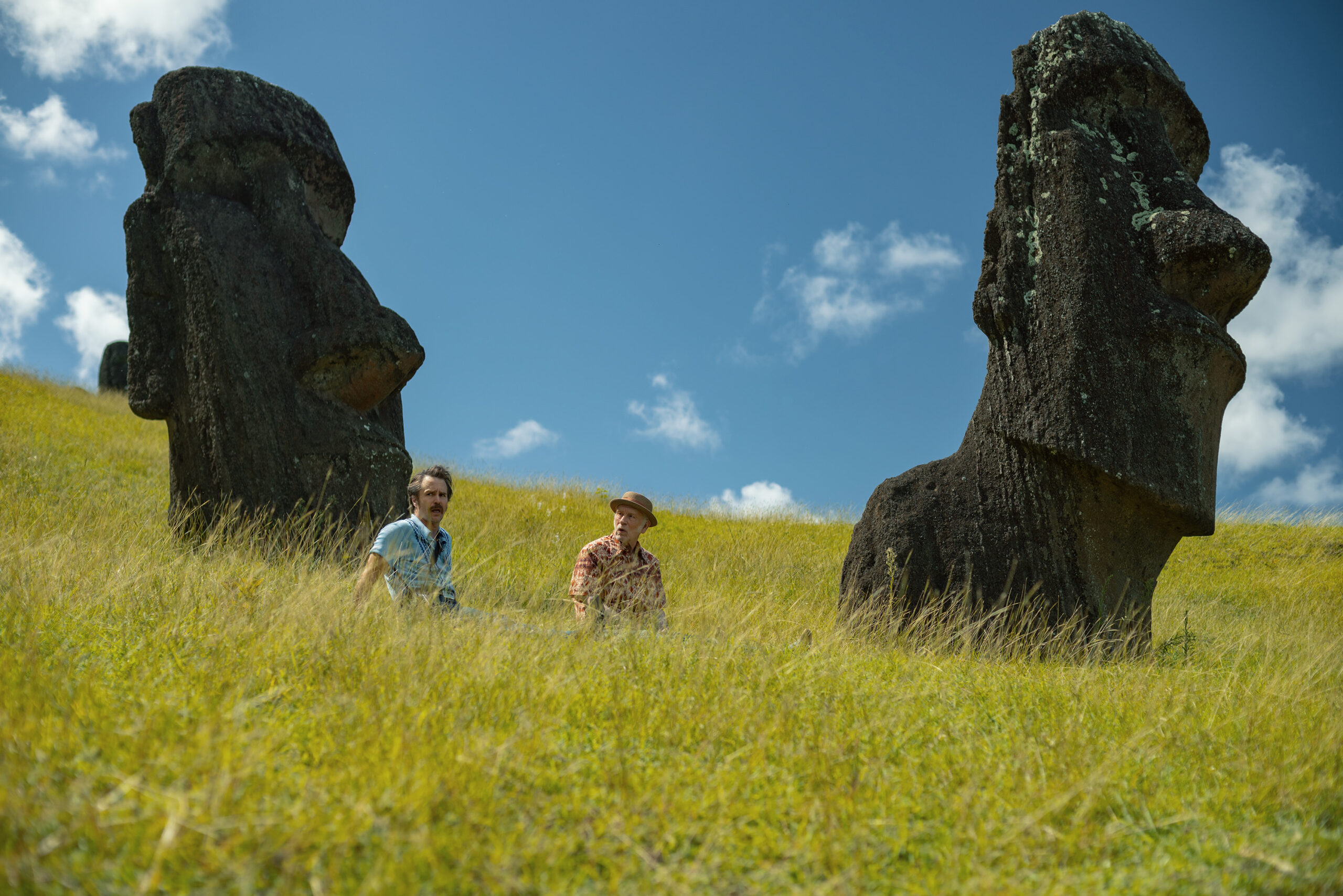
Diego Araya Corvalán/Searchlight Pictures
MOVIE REVIEW
Wild Horse Nine (2026)
Martin McDonagh seems to have a very limited range of characters: the same wisecracking, potentially sociopathic misanthropes, regardless of which cultural or historical context he drops them into. In “Wild Horse Nine,” his fifth feature, that context is Chile on the eve of the 1973 military coup, and the misanthropes are two C.I.A. agents. One of them, naturally, is played by Sam Rockwell. At this point the casting is less a choice than a punchline.
Chris (John Malkovich) and Lee (Mr. Rockwell) are longtime espionage partners stationed in Santiago when they go on a curious excursion to Easter Island. At the airport, Chris casually blows their cover to two young women (Mariana Di Girolamo and Ailín Salas) who met at a women’s-rights protest a month earlier. He treats their politics with the same glib contempt he reserves for nearly everything else, sneering at protests and equal rights and making a joke of the supposedly woke insistence on calling Easter Island by its indigenous name, Rapa Nui.
The joke is characteristic of Mr. McDonagh: a reactionary position is placed in the mouth of a character sufficiently repellent that the filmmaker can claim distance from it, while the character is nevertheless allowed to enjoy the best lines in the room. The result is an uneasy pattern that runs through Mr. McDonagh’s work. His characters may say appalling things, but because they are also funny, wounded, charismatic and occasionally capable of tenderness, their ugliness becomes part of their charm. The film doesn’t necessarily endorse their worldview. It simply makes that worldview entertaining.
Chris and Lee bicker like an old married couple who have spent decades learning precisely where to stick the knife. Chris’s wife, Marge (Parker Posey), gets her own share of the verbal abuse over the phone, while Chris, dying of cancer and increasingly afflicted by memory loss, dictates a memoir into a recorder. His thoughts wander from the possibility that dinosaurs had souls to the question of whether they might exist in heaven. The joke is funny in isolation, but it also establishes the film’s governing conceit: an old man who has spent his life deciding who deserves to live is suddenly forced to contemplate what, if anything, a life amounts to.
That is when “Wild Horse Nine” becomes considerably more interesting — and considerably more troubling.
Chris’s memory problems conceal a secret that Lee has been ordered to investigate. Their bureau chief, M.J. (Steve Buscemi), wants to know whether Chris’s memoir contains anything that could expose his role in the assassination of President John F. Kennedy. Chris, it turns out, may have been the man who pulled the trigger, and he still has the rifle. What begins as a comedy about two irritable intelligence officers stranded on an island thus becomes a conspiracy thriller about an American government whose secrets are so grotesque that even its own operatives need to be surveilled.
There is an almost perverse logic to Mr. McDonagh’s choice of setting. The real history surrounding the film is already stranger than fiction: in 1970, Richard Nixon marshalled his national-security apparatus to prevent Salvador Allende from taking office after Allende won the Chilean presidency; C.I.A. records document contacts with Chilean military officers plotting a coup and covert efforts to sustain political opposition to Allende. By 1973, U.S. officials were closely monitoring coup preparations even as Washington maintained various forms of covert pressure on the Allende government.
And then there was Sept. 11, 1973.
That date has become overshadowed in the American imagination by the Sept. 11 that came 28 years later, but in Chile it marks the destruction of a democratically elected government: military aircraft bombed La Moneda, Allende died that day, and Augusto Pinochet’s dictatorship began. The U.S. role in the years leading up to the coup is not a matter of conspiracy theory; declassified American records document the Nixon administration’s determination to prevent Allende from consolidating power and its covert involvement in Chilean political affairs. The precise question of how directly Washington participated in the final military overthrow remains more complicated than any cartoon version of history, but that complexity makes the period no less damning.
Mr. McDonagh has called “Wild Horse Nine” his most political film. He has also said that its subject now feels unexpectedly relevant, given the continuing history of American intervention abroad. The film therefore cannot be dismissed as simply another Mr. McDonagh comedy that happens to have politics in the background. Politics is the point.
The problem is whose politics.
For all the film’s attention to C.I.A. atrocities, Mr. McDonagh remains overwhelmingly interested in the men who commit them. Chile is less a country than a backdrop for the spiritual crisis of two American operatives. The Chileans whose democracy is being undermined are largely spectators to the moral education of the people undermining it. The coup is history; Chris’s conscience is drama.
This is the recurring limitation of Mr. McDonagh’s cinema. His films evidence a fascination with damaged men who have done terrible things and by the possibility that, underneath the cruelty, there is still a wounded human being worth saving. “Three Billboards Outside Ebbing, Missouri” pushed this tendency into particularly uncomfortable territory, asking the audience to reconsider a racist, violent police officer by revealing his capacity for tenderness. “Wild Horse Nine” performs a similar maneuver with an American intelligence operative. The crimes become the beginning of his character study rather than the end of the argument.
It is a seductive dramatic proposition. It is also an extraordinarily convenient one.
Lee’s dilemma — whether he is more loyal to his friend or to his employer — has genuine emotional force, especially as Chris’s health deteriorates. But the film repeatedly elevates that private loyalty above the enormous public catastrophe unfolding around it. Thousands of Chileans would eventually be imprisoned, tortured, killed or disappeared under Pinochet’s regime. The C.I.A.’s covert history in Chile is not merely an exotic backstory for a pair of eccentric American men; it is part of a political history the consequences of which were experienced by people who do not get to spend two hours on Easter Island contemplating their regrets.
Mr. McDonagh’s great talent is making terrible people sound marvelous. His characters can turn cruelty into repartee so quickly that the audience scarcely notices the moral transaction taking place. In “Wild Horse Nine,” that talent becomes almost self-defeating: the sharper the dialogue, the easier it is to forget who has actually been holding the gun.
Mr. Malkovich does much of the heavy lifting. His Chris speaks with awkward pauses and broken rhythms that sometimes seem deliberately performed and sometimes seem indistinguishable from the physical deterioration of an aging man. The uncertainty is ultimately useful. His voice has become an instrument of mortality, with sentences seeming to dissolve before they reach their conclusions. Chris is a man whose mind is losing its grip even as he attempts to impose a final narrative on his life.
That makes the memoir device more than a plot mechanism. Chris wants to turn a lifetime of covert violence into a story he can control. He has spent decades operating in secrecy, deciding which lives matter and which deaths can be justified, and now he wants to become the author of his own version of those events. The film understands the absurdity of that ambition. What it doesn’t quite understand is that remorse is not the same thing as accountability.
Mr. Rockwell, meanwhile, is deployed in the familiar McDonagh register: abrasive, funny, wounded, and just sympathetic enough to make the audience want to forgive him. His chemistry with Mr. Malkovich is undeniable. Their scenes have the rhythm of a long marriage in which affection and contempt have become indistinguishable. Mr. McDonagh has described the pair in precisely those terms, and the conceit remains one of the film’s pleasures.
But “Wild Horse Nine” ultimately asks us to care more about whether these men can forgive one another than whether the world they helped damage can forgive them.
That may be Mr. McDonagh’s most revealing political position — not a defense of the C.I.A., exactly, but an insistence that even its agents deserve the luxuriant privileges of the humanistic close-up. The people at the other end of American foreign policy rarely receive the same indulgence.
There is something almost perfectly McDonaghian about that blind spot. He has made a film about American intervention abroad and somehow still made the American interveners the most interesting people in the room.
The irony is that the film’s politics are strongest precisely where its comedy stops protecting its characters. When Chris’s jokes fall away, and Malkovich allows the weight of what this man has done to register on his face, “Wild Horse Nine” briefly becomes the movie it could have been: a reckoning with the machinery of American power rather than another elegy for the difficult men who operated it.
Instead, Mr. McDonagh keeps reaching for redemption.
He seems to believe that if a monster can make us laugh, cry, and feel sorry for him, he must still be one of us. But there is a difference between humanizing a perpetrator and asking us to absolve him. “Wild Horse Nine” never quite understands that distinction.
Like “Three Billboards,” it is a film in which white grievance is granted an almost inexhaustible supply of psychological depth. The dialogue remains razor-sharp; the performances, particularly Mr. Malkovich’s, are likely to attract awards-season attention. But beneath all the cleverness is an oddly narrow moral imagination: a movie about American power that remains, at heart, a movie about how American men feel about themselves.
Mr. McDonagh has taken us to Chile to contemplate the C.I.A., and somehow we end up back where he has always been most comfortable — in the company of two damaged white guys, listening to them explain themselves.
The coup is history. Their feelings are the story.
And that, finally, may be the most McDonagh thing of all.
Comments