Neon
MOVIE REVIEW
Fjord (2026)
With “Fjord,” Cristian Mungiu becomes the 10th filmmaker to win the Palme d’Or twice — not that membership in this particular club necessarily confers a place among the world’s cinematic immortals. Mr. Mungiu, whose “4 Months, 3 Weeks and 2 Days” won the prize in 2007, is hardly the only Romanian New Wave filmmaker of consequence, either; these days, the movement’s most restlessly inventive figure is arguably Radu Jude. Still, “Fjord” is a defensible choice from a Cannes competition that offered no obvious front-runner. It is also a thoroughly depressing, frequently unpleasant film, one whose bleakness might be easier to bear if its moral provocations were more illuminating than exasperating.
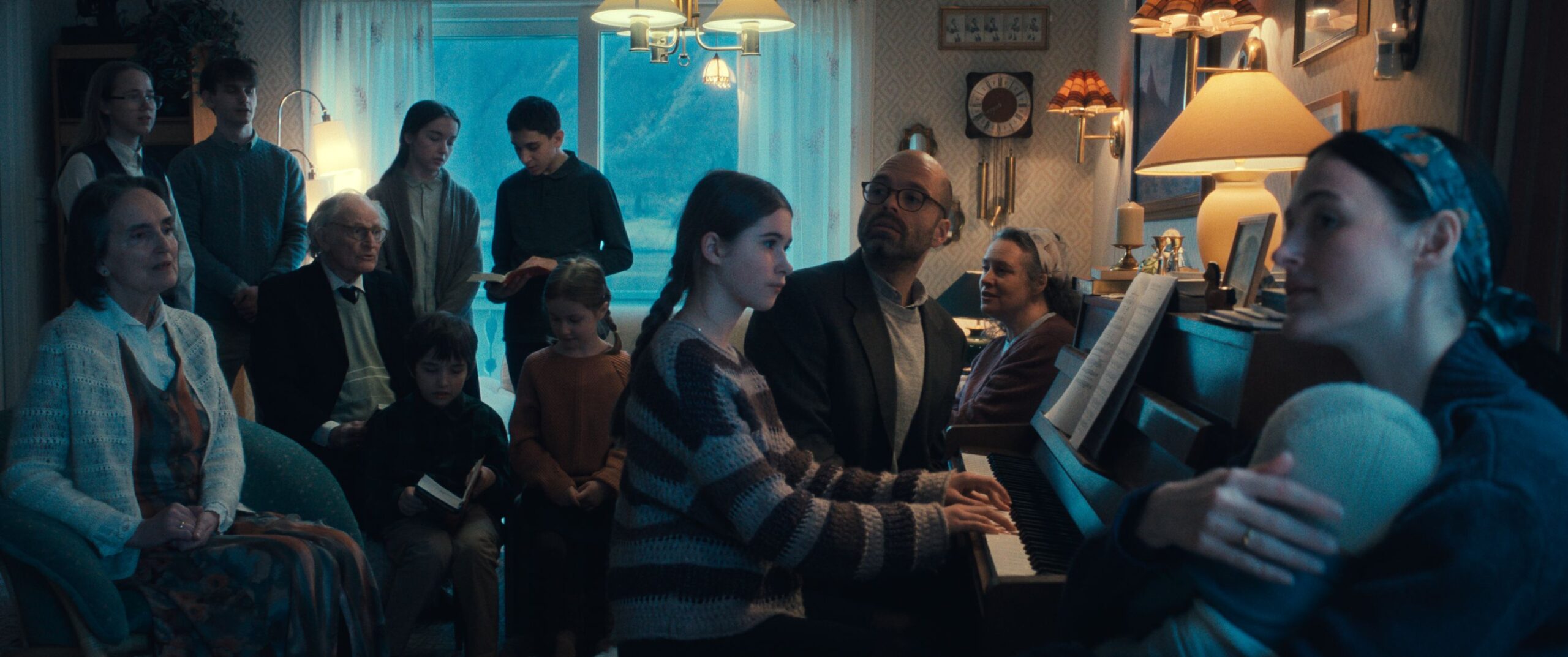
Sebastian Stan and Renate Reinsve, who previously appeared together in “A Different Man,” reunite as Mihai and Lisbet Gheorghiu, a deeply religious Pentecostal couple who uproot their family from Romania and settle in a remote Norwegian village. Whatever American influence the casting might suggest, the film otherwise bears the unmistakable austerity of Mr. Mungiu’s oeuvre. The Romanian director’s signature grayish gloom descends upon these new surroundings as relentlessly as it did his old ones, as though even the snow-covered Norwegian landscape cannot escape his worldview.
Mihai and Lisbet arrive with their five children and begin the laborious business of establishing a life in an unfamiliar place. They meet their neighbors, settle into new jobs and schools, and try to make themselves at home. Their new community initially seems friendly enough. But the welcome, it turns out, has conditions.
One night, Elia (Vanessa Ceban), egged on by Elsa (Sofie Vartdal), a neighbor roughly her age, sneaks out by leaping from her bedroom window, sustaining a bruise in the process. To the girls, the incident is unremarkable; to the adults at school, however, the mark suggests something more sinister. Child protective services is alerted, and what might have been an ordinary episode of adolescent mischief becomes the opening salvo in a bureaucratic and legal ordeal. The Gheorghius’ religious convictions soon become inseparable from suspicions about their parenting, and the machinery of institutional intervention begins to grind: family court, foster care, the prospect of separation. Before long, the family finds itself fighting a system that appears to have mistaken cultural difference for evidence of abuse.
The film’s predicament is that nearly everyone in it seems determined to make an already bad situation worse. Mr. Mungiu has never been a filmmaker inclined to flatter his characters, but “Fjord” turns unpleasantness into something close to a governing principle. Mihai is a hothead whose patriarchal assumptions and hair-trigger temper make him an imperfect vessel for the audience’s sympathies. Yet it is not difficult to understand his fury when he believes his children are being taken from him on false pretenses. The Norwegian authorities, meanwhile, may consider themselves protectors of the vulnerable, but their confidence in their own moral rectitude leaves little room for the possibility that they have misread the the situation before them.
Norway’s reputation as a prosperous, socially progressive country, frequently celebrated in international happiness rankings, makes an especially convenient backdrop for this clash of worldviews. What happens when a society’s faith in its own benevolence becomes a form of blindness? The Gheorghius are outsiders in more ways than one: Romanian immigrants, religious conservatives, and parents whose understanding of family life does not conform to the secular liberal assumptions of their new home. Their treatment invites an uncomfortable question about the limits of a supposedly tolerant society. How much difference can it accommodate before tolerance gives way to suspicion?
The question becomes more troubling when one considers who else might be made to feel unwelcome in this supposedly enlightened community. If the Gheorghius’ foreignness and religious fervor are enough to render them suspect, what might the experience be for people of color in a place whose social cohesion is so often celebrated? Mr. Mungiu gestures toward the insularity of a homogeneous society, but his film’s bleakness threatens to flatten an important distinction: the difference between a community that fails to recognize its own prejudices and one in which every individual is simply as awful as everyone else.
The film’s most persuasive asset may be its casting. Mr. Stan and Ms. Reinsve bring a lived-in familiarity to a marriage under siege, and Mr. Stan, in particular, disappears so completely into Mihai that I initially took him for a Romanian actor. His performance is all the more convincing for the absence of conspicuous effort; even when he speaks English, the accent seems so thoroughly absorbed into the character that it scarcely registered with me. The casting is a reminder that an actor’s recognizability can be a liability as well as an asset. Mr. Stan’s star persona recedes, leaving behind a man whose volatility is not merely a dramatic flourish but a source of genuine discomfort.
Yet the very effectiveness of Mr. Stan’s performance exposes a weakness in Mr. Mungiu’s construction. Moral ambiguity is not the same thing as moral indecision, and a film need not distribute sympathy equally to remain intellectually honest. But “Fjord” appears to have settled the central question of Mihai’s innocence before it has done the harder work of examining what his behavior might mean. The audience is left to choose between religious zealots and secular bigots, as though the only available positions were to endorse the family’s worldview or excuse the authorities’ prejudices. In the American context, the two categories can overlap more than either side might care to admit. Religious conviction can become a warrant for intolerance; the language of social progress can be used to disguise it. Neither side has a monopoly on self-righteousness.
What is missing is a more searching account of how these competing certainties become so destructive. Mr. Mungiu seems less interested in examining the possibility that everyone has something to answer for than in demonstrating that everyone is terrible. The result is a film that mistakes the accumulation of grievances for moral complexity. Its misery is not without purpose, but its insistence on misery can feel like an argument that has run out of things to say.
The five children, meanwhile, are left to absorb the consequences of a conflict they did not create. They have formed bonds with one another, and their relationships offer the film its most affecting glimpse of a life beyond the adults’ competing dogmas. One might wonder why Elia and Elsa do not simply explain what happened that night, sparing their families at least some of the ordeal. But that question risks assigning children a degree of agency that the adults around them have already denied them. Their silence may be less a solution withheld than another casualty of a world in which every innocent act is liable to be reinterpreted as evidence in somebody else’s case.
In “Fjord,” the adults are so busy deciding what kind of people the others are that they lose sight of the children caught between them. The film’s tragedy is not simply that a family is misunderstood, or that a community’s self-image proves less generous than advertised. It is that everyone’s certainty becomes more important than anyone’s welfare. Mr. Mungiu may have earned his second Palme d’Or, but his vision of human folly is so relentlessly airless that the film leaves little room for the one thing its characters most desperately need: the possibility that someone, somewhere, might be willing to reconsider.
Comments