Film Movement
MOVIE REVIEW
Case 137 (2025)
The U.S. release of “Case 137” has the peculiar timing of a film arriving late to its own moment. Having premiered at Cannes in 2025, Dominik Moll’s police procedural has forfeited much of the festival buzz that might have helped propel its U.S. release. But the delay has yielded an inadvertent advantage: a film about police brutality during France’s 2018 Yellow Vests protests arrives as a new wave of student demonstrations, fueled by grievances over public services and met by forceful police responses, has begun to evoke that earlier period of unrest. As images of teargas-clouded streets and burning debris circulate across social media, the past seems less past than prologue. Film Movement, the American distributor, may not have anticipated the convergence. No marketing campaign, at any rate, could have manufactured a more persuasive argument for the film’s urgency.
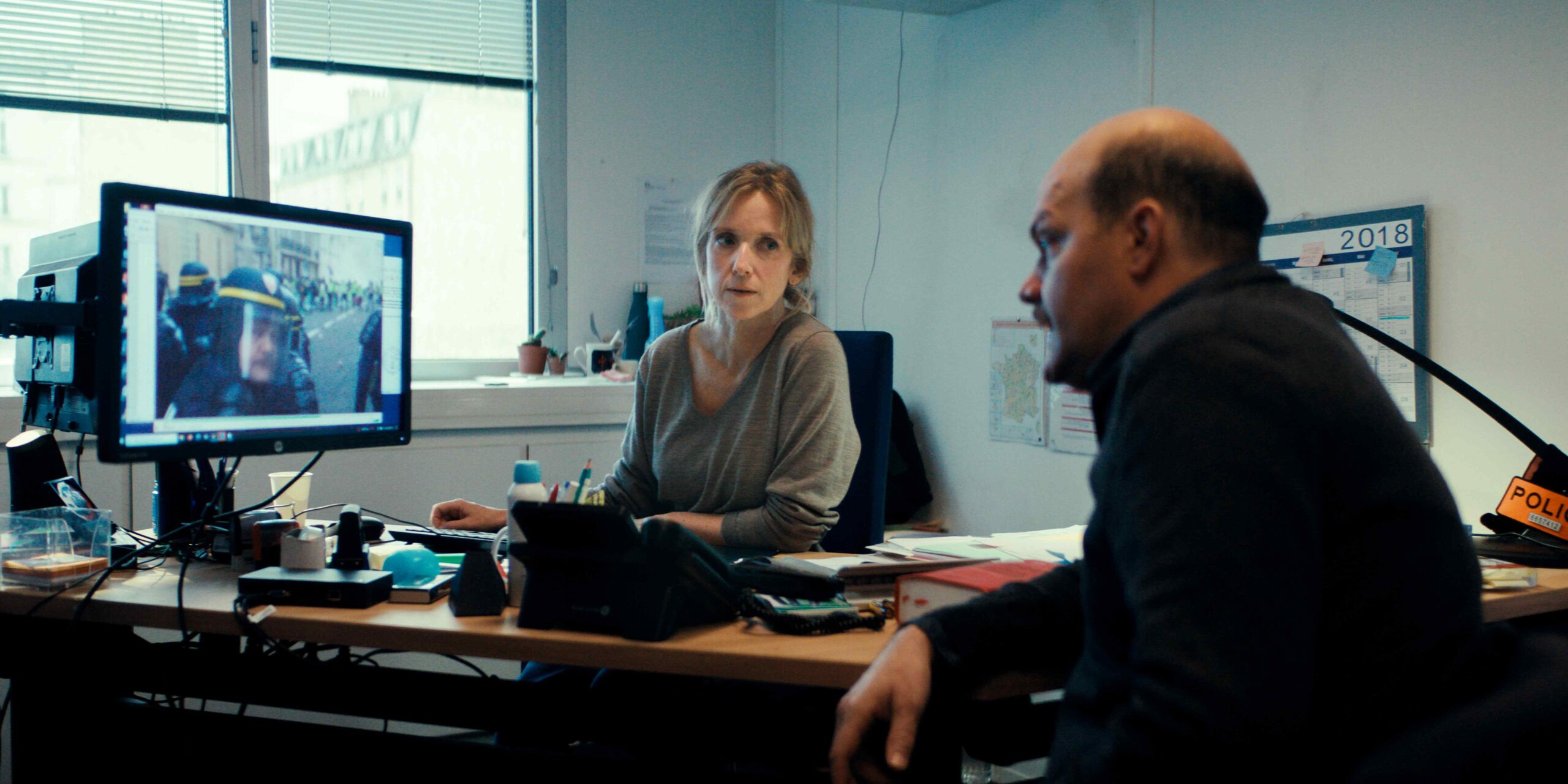
In “Case 137,” Léa Drucker plays Stéphanie Bertrand, an internal affairs investigator looking into allegations that a police officer fired a riot gun at a young protester, Guillaume (Côme Peronnet), who suffered a fractured skull. Rémi (Valentin Campagne), who was with Guillaume at the demonstration, insists that his friend did nothing to warrant such violence, though his anger toward the investigators soon curdles into resignation. He knows the predicament: it is his word against theirs, and the balance of credibility has been tilted long before anyone begins taking statements.
Bertrand’s inquiry proceeds through the familiar rituals of institutional self-protection. Officers close ranks, offering accounts that begin to unravel when juxtaposed with surveillance footage. Even when the evidence threatens to expose them, their indignation remains intact; the investigation is an inconvenience, their time too valuable to be wasted on it. Bertrand eventually tracks down Mady (Guslagie Malanda), a housekeeper at the hotel across the street from the incident, who might have witnessed the attack. But Mady, understandably, has little appetite for becoming entangled in a confrontation with the police. The truth may be visible, but visibility is not the same as justice — and witnessing wrongdoing is one thing, volunteering to suffer the consequences of testifying to it quite another.
There is something deeply dispiriting about watching Bertrand work her way through these obstacles, though little of it is particularly surprising to anyone who follows the news beyond official pronouncements and the latest conspiracy podcast. Injustice, after all, rarely announces itself as such. More often, it arrives in the form of procedure, professional courtesy, carefully coordinated recollections, and the weary insistence that nothing can be done. The system need not destroy the truth outright if it can exhaust everyone who tries to establish it.
This is where Mr. Moll’s restraint becomes the film’s greatest asset. Rather than inflate the investigation into a melodramatic showdown between one righteous investigator and a uniformly corrupt force, he attends to the small humiliations and bureaucratic evasions through which accountability is obstructed. The result is not exactly a revelation; it is an accumulation of frustrations, each one depressingly legible. Mr. Moll, best known to American audiences for his 2000 film “With a Friend Like Harry . . . ,” explored a similarly maddening investigative dead end in “The Night of the 12th” (2022), a police procedural whose unsolved case became an indictment of the assumptions and blind spots embedded in the institution charged with solving it. “Case 137” extends that interest in the limits of official inquiry, but its subject gives the procedural a more immediate political charge.
A police investigation can establish what happened without necessarily changing anything. That gap between evidence and consequence is the film’s bleakest insight — and the source of its unexpected resonance in an increasingly authoritarian moment. Mr. Moll need not have anticipated the present political climate for his film to speak to it. Indeed, “Case 137” is most effective when it resists the temptation to announce its own significance. Its portrait of impunity is all the more unnerving for being so matter-of-fact.
The film may not offer the catharsis of an exposé, much less the sweeping revelations promised by documentaries about oligarchs or the perpetrators of genocide. Its subject is more modest, and in some ways more disturbing: the ordinary mechanisms by which power insulates itself from scrutiny. There is no guarantee that justice will result from finding the truth, or that a witness will be protected for telling it, or that an institution will recognize wrongdoing simply because the evidence is staring it in the face. In “Case 137,” the machinery of accountability is not necessarily broken. It may be functioning precisely as intended.
That is what makes the film feel indispensable now. Not because it predicts the headlines, but because it illuminates the conditions that spawn them.
Comments