Jaap Buitendijk/Paramount Pictures
MOVIE REVIEW
Ebenezer (2026)
Charles Dickens’s “A Christmas Carol. In Prose. Being a Ghost Story of Christmas,” published in 1843, has been adapted so many times, in so many formats, that the story’s perpetual presence now haunts us more reliably than anything inside it. “Ebenezer” is possibly the 10th feature film spun from the source, though nobody can say for certain, since some earlier versions are now lost.
Going in, I knew almost nothing about this one apart from its star, Johnny Depp, an alleged domestic abuser, as the miser himself. Imagine my surprise, then, when Ti West’s name surfaced in the opening titles under the director header. Another studio might have made an event of that, with 70mm, 35mm, VistaVision and the whole fetishist’s menu. Paramount is not that studio. The film arrives with all the fanfare of a utility bill.
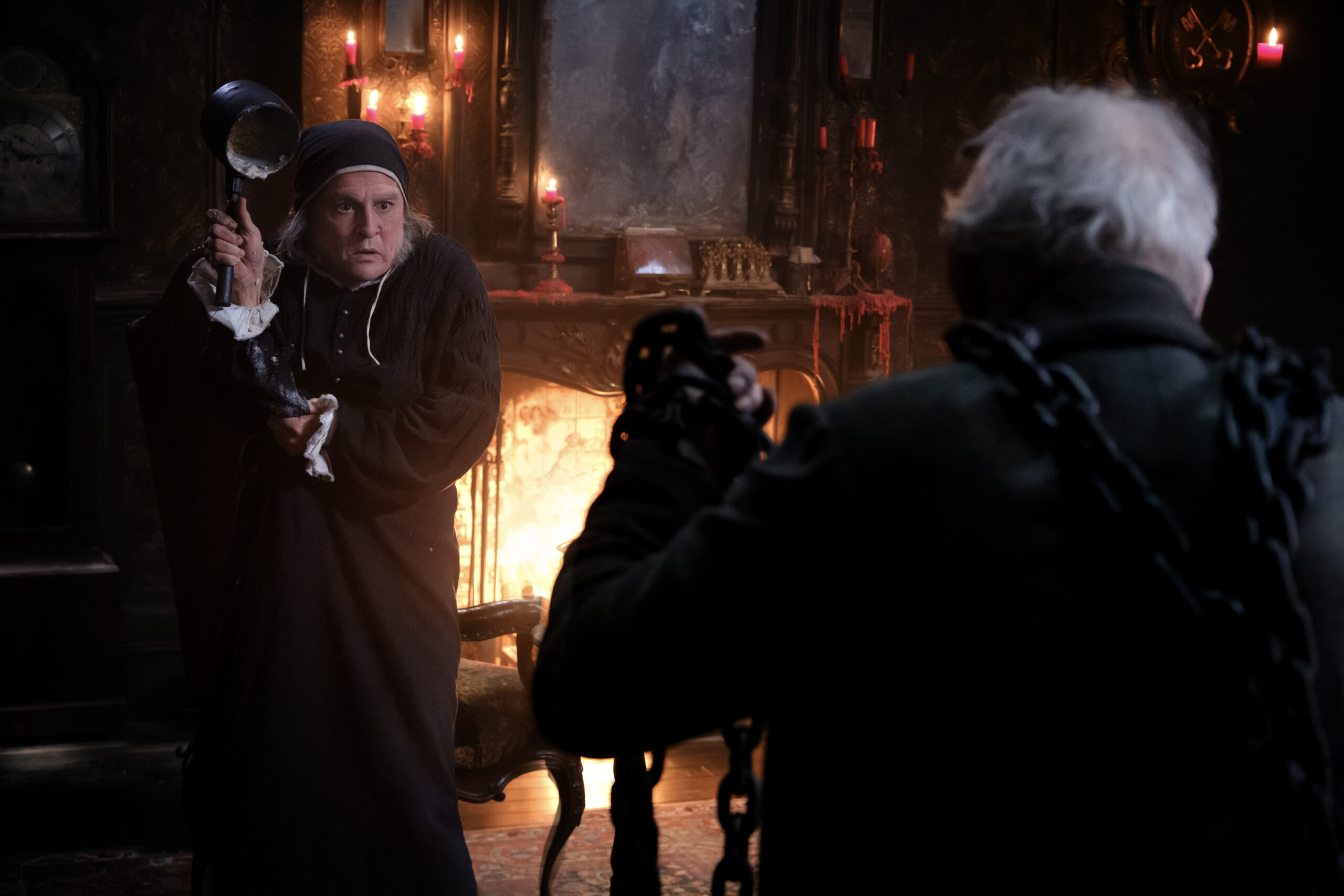
Coming off the “X,” “Pearl” and “MaXXXine” trilogy, it seemed a no-brainer that Mr. West would again reach back into the grammar of old cinema. The attempt is evident here, but it stops at the surface, at dated title cards that announce a period without inhabiting one. He may have been aiming for giallo, or the fevered excess of “The Devils.” What he has delivered is bargain-basement Robert Eggers: the candlelit gloom and the antique diction, minus the obsessive craft that makes those things frightening.
The film might have worked better had it gone fully analog, the lo-fi, handmade dread that has been a staple of J-horror. Consider the difference between Sadako crawling out of the television in “Ringu” and Samara doing the same in “The Ring.” The first is grainy and wet and physically contorted. The second is polished such that it looks like vapid commercial produce. The holograms here belong to the Samara school, unnecessarily digitized and cheaply so. They read as A.I. rather than C.G.I., like the rush-job effects that get passed around online as punch lines. The one element on a par with Mr. Eggers’s films is the sound mix, which is so aggressive, so deafening, that much of the dialogue is lost. A ghost story should make you lean in. This one makes you want to reach for the volume button, then give up.
Heavily uglified, Mr. Depp credibly blends into a role that seems to call for someone much older, and perhaps for the cartoonish villainy Jim Carrey brought to the part in 2009. The supporting cast fares worse. Ian McKellen, as Ebenezer’s late partner, Jacob Marley, and Rupert Grint, as their exploited clerk, Bob Cratchit, are criminally underused. Casting actors of that caliber and then leaving them nothing to play is its own kind of miserliness.
The truly fascinating thing about “Ebenezer” is happening behind the scenes. Here is a tale about a wealthy misanthrope who learns the error of his ways through a series of paranormal encounters, and it comes from the studio owned by David Ellison, currently one of the most reviled oligarchs of our time. His father is the billionaire Larry Ellison. Has the lesson sailed completely over both their heads? One imagines their screening room as the only haunted house in Hollywood whose owners never feel a chill.
Then again, the parable has always been softer than its reputation. Over the course of Ebenezer’s encounters with the spirits, Dickens granted both an excuse and a path to redemption for a man who might well be irredeemable. Ebenezer thinks everything and everyone revolves around him, and the ghosts must physically drag him into other people’s lives because he cannot, on his own, put himself figuratively into their shoes. His cure is a change of heart, a turkey and a raise. It is not a change of system. The story asks the rich to be kinder, never to be less rich.
That may be why it has resonated for nearly two centuries, and why it makes such a comfortable holiday tradition for the people it should indict. A century and a half of the tale hasn’t deterred the Ellisons of the world from becoming supervillains. If anything, they have taken it as a business plan: be warned once, be generous once, and keep the building. “Ebenezer” can’t scare them, and it barely scares us. Its strongest impression is that of a ghost story haunted by its own bank balance.
Comments