Dekanalog
MOVIE REVIEW
Hen (2025)
Walking out of a 2007 Tribeca Festival screening of “Taxidermia,” I was convinced I had just watched one of the world’s great filmmakers announce himself. The world, apparently, never got the memo. In the two decades since that film premiered in Cannes’s Un certain regard section, György Pálfi has all but vanished from this side of the Atlantic. It didn’t help that “Final Cut: Ladies and Gentlemen,” his 2012 feature assembled from 451 excerpts of other people’s movies, was effectively unreleasable: fair use stipulated that it could be shown only free of charge, which is a hard business model to build a career on. A 2024 retrospective at the Brooklyn Academy of Music suggests I’m not entirely alone in my assessment, but a cult of the converted is cold comfort.
His latest, “Hen,” arrives with a better pedigree. It premiered in the Platform section of the Toronto International Film Festival, a sidebar at one of the planet’s most visible fests outside the Big Three, and, miracle of miracles, it has American distribution. Consider it a sign that we might be seeing more of him.
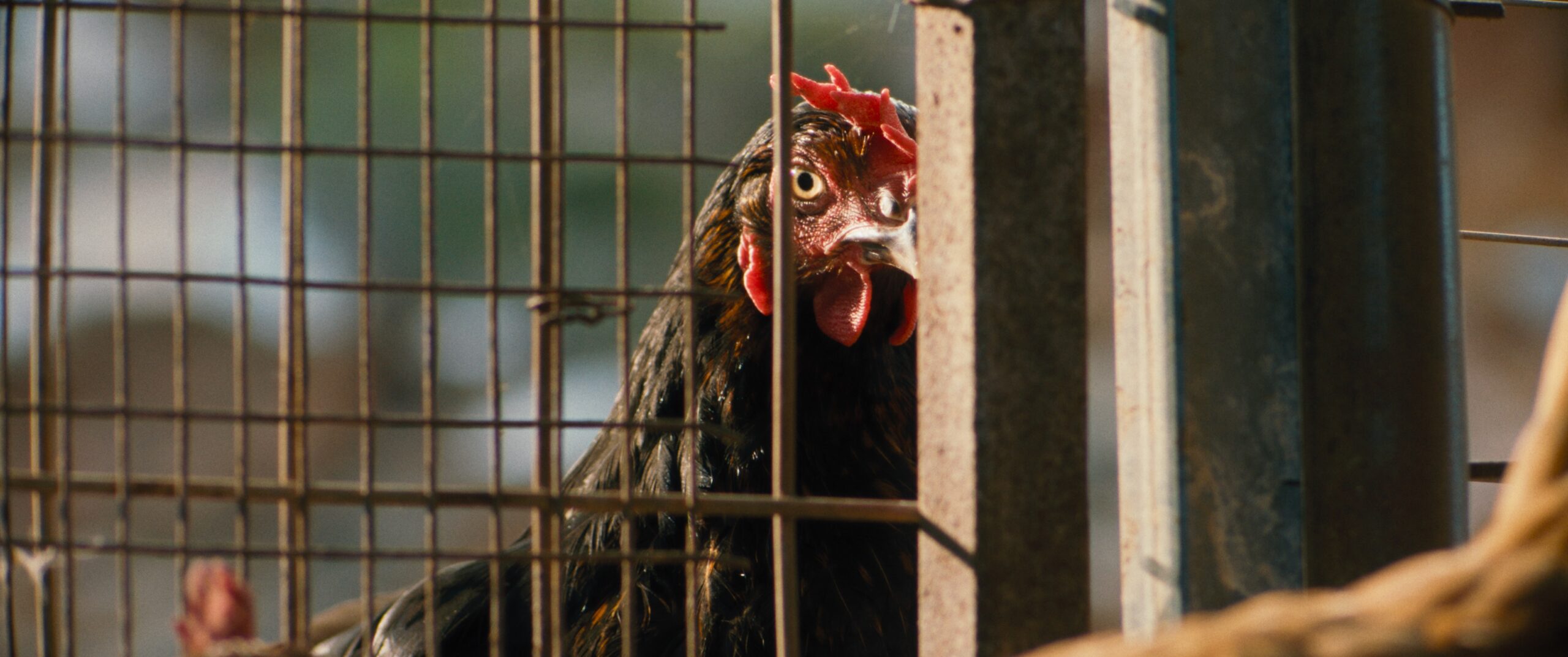
The story is told from the perspective of a hen. Yes, really. Played, per the press notes, by eight different hens, she is a heroine without a name, a voice, or a single line of dialogue. Jerzy Skolimowski’s “EO” (2022) will inevitably enter the discourse, but Mr. Pálfi was working in this near-wordless register as far back as 2002’s “Hukkle,” and he has never needed a donkey’s permission.
The opening movement is a masterclass in industrial dread. Our heroine’s egg is laid on a factory farm, plucked from its bed alongside its fertilized brethren, and rocked in the mechanical embrace of robotic cradles. After hatching, the chicklings pour down a literal pipeline. They eat, they drink, they grow. When shipping day comes, a worker singles her out as the centerpiece of his wife’s soup. Her imprisonment ends, but her death sentence goes uncommuted.
Then comes a flash of freedom: while the worker’s truck idles at a gas station, she slips out through the driver’s-side window. By morning she is a wolf’s prey, and the film lurches into full action-flick mode, a chicken’s version of “The Fugitive.” After a few detours, a dog snatches her and delivers her to Giorgos (Yannis Kokiasmenos), the grizzled keeper of a defunct seafood restaurant. Thrown into his coop, she is hounded by the mean girls until the resident rooster appears. On the soundtrack, Grigoris Bithikotsis’s romantic ballad “Episimi Agapimeni” swells nondiegetically, cheekily dressing up a courtship, while the mating we actually see on screen reads as anything but consensual. It’s a brutal gag, and a deliberately uncomfortable one.
In the background, a human subplot simmers. Nikos (Argyris Pandazaras), the partner of Giorgos’s daughter (Maria Diakopanayotou), is mixed up in shady business that turns out to be human trafficking, and the film draws pointed parallels between the caged birds and the migrants being smuggled. This is hardly a spoiler, since the main event is the heroine’s quest to reproduce while her eggs keep getting poached, in more ways than one, by Giorgos. The film’s thesis is that confinement and exploitation are species-blind, and it makes the point with the subtlety of a mallet.
Mr. Pálfi’s perverse sense of humor remains intact, even if at times it’s a bit too on the nose. Our heroine watches a cartoon on television in which a chickling emerges from its eggshell. Later, from outside a window, she is made to watch Giorgos crack eggs open, beat them, and fry them in a pan. What makes the scene perverse is less what he does to the eggs than the fact that she has to bear witness to it.
It’s apparent that Réka Lemhényi’s suggestive editing is doing the heavy lifting narratively. The production also employs expert animal trainer Árpád Halás, a reminder that this is a film and the hens are, in a sense, acting. But that doesn’t relieve my discomfort at watching animals mate in a manner that registers as nonconsensual, prey on other species, and resort to cannibalism. We see a worm, a rat, and a chicken consumed by another species, and at one point the hen herself is fed what looks like chicken. It could be a prop, plant-based meat dressed up for the camera, but we don’t know. Between the rapey chicken sex and the cannibalism, “Hen” often plays like a nature documentary scripted by the Marquis de Sade. Regardless of whether it’s animal cruelty or simply nature, one thing is certain: the film will make you seriously consider veganism.
Comments