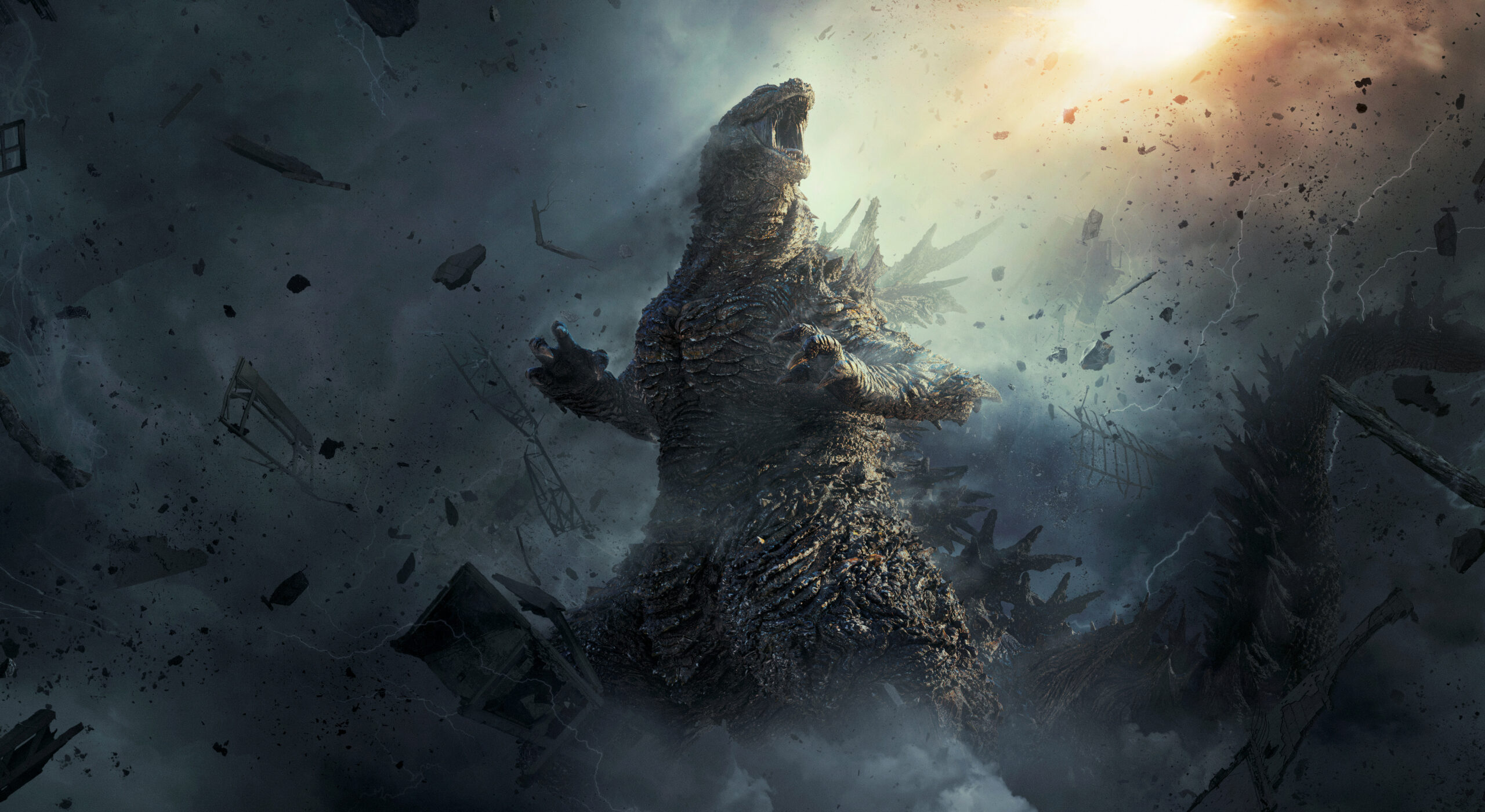
©2026 Toho
MOVIE REVIEW
Godzilla Minus Zero (2026)
At the New York Film Festival world premiere of “Godzilla Minus Zero,” the writer-director Takashi Yamazaki took the stage and begged the audience not to spoil anything. It’s an understandable request. Any filmmaker would like the regular paying crowd to taste surprise, if any, the way the festival crowd did. But what really counts as a spoiler? How granular must our discretion get? Is everything in the trailer still fair game? The studio had already posted behind-the-scenes footage online, so the monster was out of the bay well before release. Anyway. The film is now in Imax theaters, the first Japanese production to be filmed in the format. The festival didn’t have the capacity to screen that version, so I can’t say whether the larger canvas is an enhancement or merely a bigger place to be bored. Let’s get into it.
The story opens in 1949, two years after the events of “Godzilla Minus One,” with Japan still recovering from the havoc the world-famous kaiju left in its wake. Noriko (Minami Hamabe) is now married to Kôichi (Ryûnosuke Kamiki), the former kamikaze pilot, and she wears an eye patch full time, though not for the reason you might guess. The couple have adopted Akiko (Sae Nagatani), who struts around the orphanage – where Noriko now works – like a kid who has discovered she’s the main character and intends to enforce it on the other children.
Unfortunately for this family, the universe has no interest in giving them a break. A second kaiju, one who is not Godzilla, is gathering strength offshore, scrambling the weather and spinning up storms that body-slam everything in their path. Dr. Murakami (Min Tanaka), a biologist who has lived with post-traumatic stress since Hiroshima, has been filming the creature with an assistant who is about to become a casualty. He carries his footage to Noda (Hidetaka Yoshioka), the naval weapons expert now running the Large-Scale Disaster Response Bureau, where meteorologist Aoyama (Masami Nagasawa) is arriving to lend her expertise. Every one of them has the haunted gravity of a character in a postwar art-house drama, which would be fine if the movie were interested in what they do with it.
This next stretch is spoiler territory, since none of it made the trailer, so skip ahead if you’d rather not know. The Bureau tries a few tactics borrowed from the last film. They fail. Worse, they turn the new kaiju into a literal three-headed monster. No, not Hydreigon. It’s King Ghidorah we’re talking about, and the distinction matters only to the sort of person who has strong feelings about both. Things look all kinds of hopeless until someone proposes a last resort: lure King Ghidorah to Godzilla’s resting place in Sagami Bay and let the two settle it , like a family feud staged for a studio audience. This is where Noriko’s eye patch earns its screen time.
As with its predecessor, “Godzilla Minus Zero” boasts period mise en scène so convincing that it passes as prestige cinema rather than kaiju eiga. It looks like Masterpiece Theatre with a body count. Regrettably, Anri Jôjô’s production design is the only thing the franchise has going for it this time. Na Hong-jin’s “Hope,” a contemporary-set creature feature that debuted at Cannes in May and reached American theaters two months ago, is the better movie in nearly every respect: the acting, the screenplay, the direction, the editing. This is one kaiju showdown Mr. Yamazaki, whose background is in visual effects, clearly didn’t see coming. A monster movie that loses a head-to-head with another monster movie has a problem that no amount of period-accurate lampposts can fix.
Don’t mistake this for a complaint about melodrama. The film isn’t overwrought, which would at least imply a pulse. The trouble is that Mr. Yamazaki can stage a scene only when it’s a genre set piece, and the moment the monsters leave the frame, so does the filmmaking. The Large-Scale Disaster Response Bureau is eerily calm for a body charged with preventing the end of the world. Whenever Noda delivers a speech, everyone drops what they’re doing and stands motionless to receive it, like congregants waiting on the benediction, or like extras who have just heard “hold for sound.” It’s just ridiculous. The staff of “Abbott Elementary” can at least stride down a hallway with purpose and conviction to look busy when things are nowhere near this dire. Ava Coleman, on her laziest day, would have at least carried a clipboard.
That’s the whole problem in miniature. Mr. Yamazaki can build a monster. He can’t make a room full of people look like they have somewhere to be.
Which brings us back to the question he raised at the premiere. A spoiler, if you’re keeping score, is whatever robs a viewer of a discovery. By that definition the festival crowd and the Imax crowd are on equal footing, because the one thing the filmmakers should have begged us to keep quiet is how little is behind the curtain. The creature design is a marvel, the sets are lovely, and the destruction has real heft. Everything else is a stand-in, the human drama a waiting room between rampages. “Godzilla Minus One” understood that a monster only frightens us when someone we love is standing in its path. “Godzilla Minus Zero” has the path, the monster, and even a love interest, but can’t be bothered to make us care who gets stepped on.
Comments